


















































A former commercial airline pilot has been charged with hijacking and terrorism-related offences following a serious aviation incident that caused temporary disruption at Vancouver International Airport earlier this week.
The man, identified as Shaheer Cassim, allegedly took unauthorized control of a Cessna 172 light aircraft from Victoria International Airport on Tuesday afternoon and flew it directly into the controlled airspace above Vancouver’s airport. The flight prompted emergency responses from airport authorities and national defense forces, including the scrambling of fighter jets.
The aircraft reportedly departed Victoria just before 1:00 p.m. and made a direct flight path to Vancouver International Airport (YVR). Upon reaching the airport, the aircraft began circling at an altitude of approximately 500 feet, which is considered highly unusual and potentially dangerous in such a congested airspace. This prompted immediate concern from air traffic controllers.
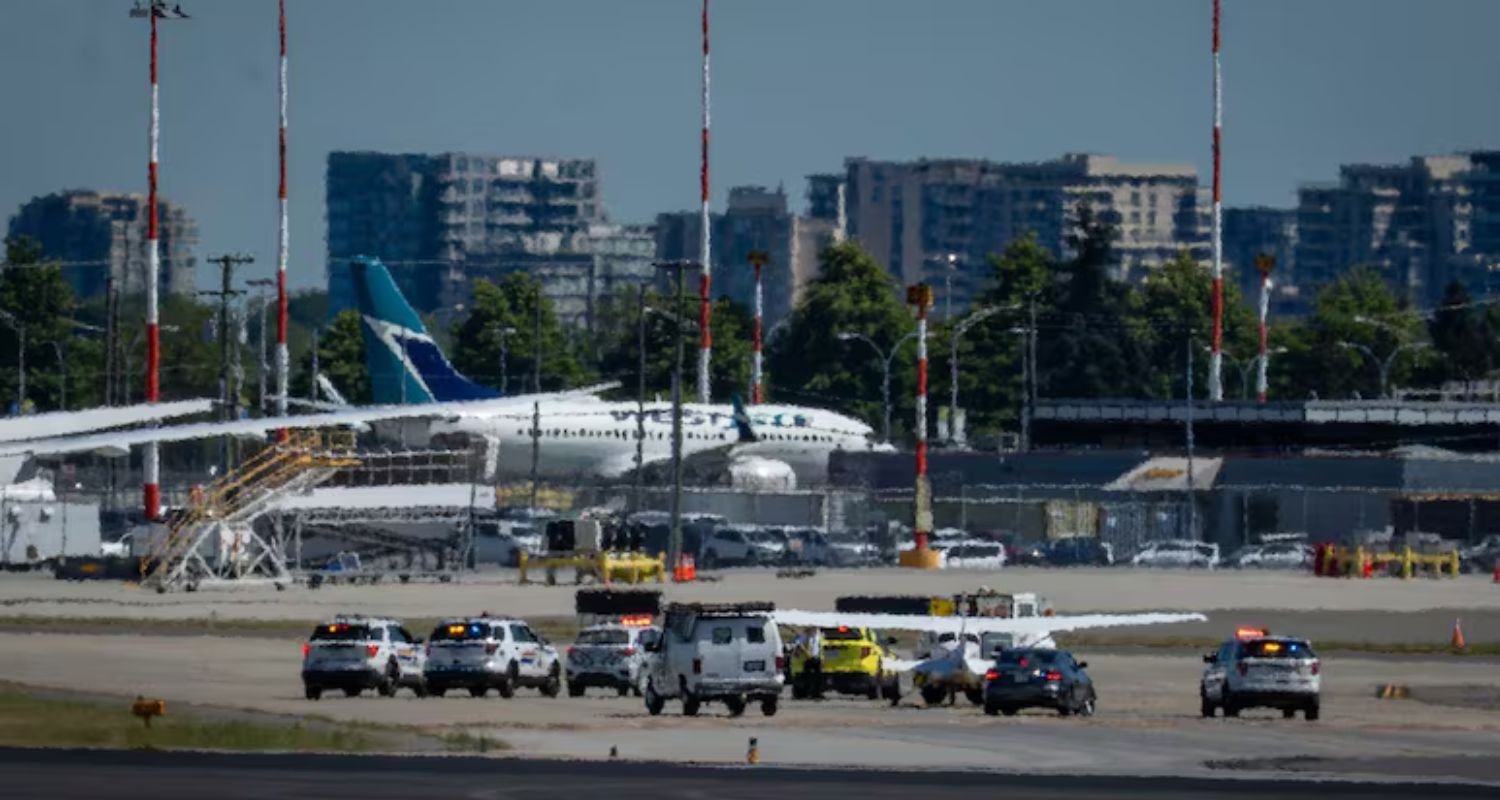
According to officials, the Cessna circled over the airport for about 25 minutes before landing at approximately 1:45 p.m. During that time, landings at the airport were halted, and several flights were delayed or diverted as a precaution. The Vancouver Airport Authority later confirmed that a 39-minute ground stop was implemented during the event.
Upon landing, police vehicles quickly surrounded the small aircraft. Eyewitness videos showed the pilot exiting the plane and walking backwards toward law enforcement officers with their weapons drawn. The pilot complied with commands and was taken into custody without incident.
North American Aerospace Defense Command (NORAD) confirmed that it had scrambled F-15 fighter jets in response to the incident. While Canadian CF-18s were also placed on standby, the Cessna landed before the aircraft could be intercepted. A NORAD spokesperson confirmed that no military engagement occurred because the suspect landed voluntarily.
The Royal Canadian Mounted Police (RCMP) has not publicly disclosed a motive. However, a recorded conversation between air traffic controllers and a grounded pilot suggests the flight may have been part of a protest. In the conversation, which has been archived online, one controller refers to the circling aircraft as possibly involved in “some kind of protest.” They mention that the situation could persist for some time, though the plane ultimately landed within minutes of the exchange.
The Public Prosecution Service of Canada has confirmed that Cassim faces charges of hijacking—defined under Canadian law as a terrorist offence. He also faces related aviation and public safety charges. If convicted, he could face a maximum sentence of life in prison.
Court documents and media reports have identified Cassim as a former commercial airline pilot. He gained public attention in 2012 when he launched a cross-country cycling campaign to raise awareness about global warming. At the time, he held a press conference in Victoria describing himself as both an environmental advocate and a professional pilot.
Sources familiar with his background report that Cassim once worked for a small regional airline in British Columbia and received his aviation training in Alberta. Former colleagues have described him as intelligent and passionate, though some suggested that in recent years he may have struggled with personal or mental health issues.
The Victoria Flying Club, which owns and operates the aircraft used in the incident, issued a brief statement confirming their cooperation with investigators. The club declined to provide further details, citing an ongoing investigation. It is believed that Cassim, posing as a licensed pilot, gained access to the aircraft and initiated a startup procedure known as a “static start,” commonly used during training or pre-flight checks, before taking off.
The incident has raised broader concerns about aviation security at smaller airports and flying clubs. Unlike commercial airliners, light aircraft are not subject to the same strict security protocols. Experts argue that while security measures like locked hangars and key control exist, there may be vulnerabilities that could be exploited by individuals with prior aviation experience.
No injuries or physical damage were reported during the incident, though the disruption affected multiple scheduled flights and created widespread confusion among travelers. Nine inbound flights were reportedly diverted while the Cessna remained airborne.
Cassim is currently in custody and undergoing a court-ordered psychological assessment to determine whether he is fit to stand trial. A bail hearing is scheduled for July 22, at which time prosecutors are expected to provide additional evidence related to his actions and potential motivations.
Authorities continue to investigate the incident, including reviewing Cassim’s online activity, prior affiliations, and any public statements. Though no official statement has been made regarding his ideological intent, his past environmental activism and unusual behavior suggest the event may have been politically or symbolically motivated.
The case has sparked renewed discussion about how to balance freedom of expression with public safety in airspace, especially in an era where individuals may attempt to use small aircraft as platforms for protest or attention.
As the legal process unfolds, Canadian aviation and security authorities are expected to review protocols at general aviation facilities to prevent similar incidents in the future.