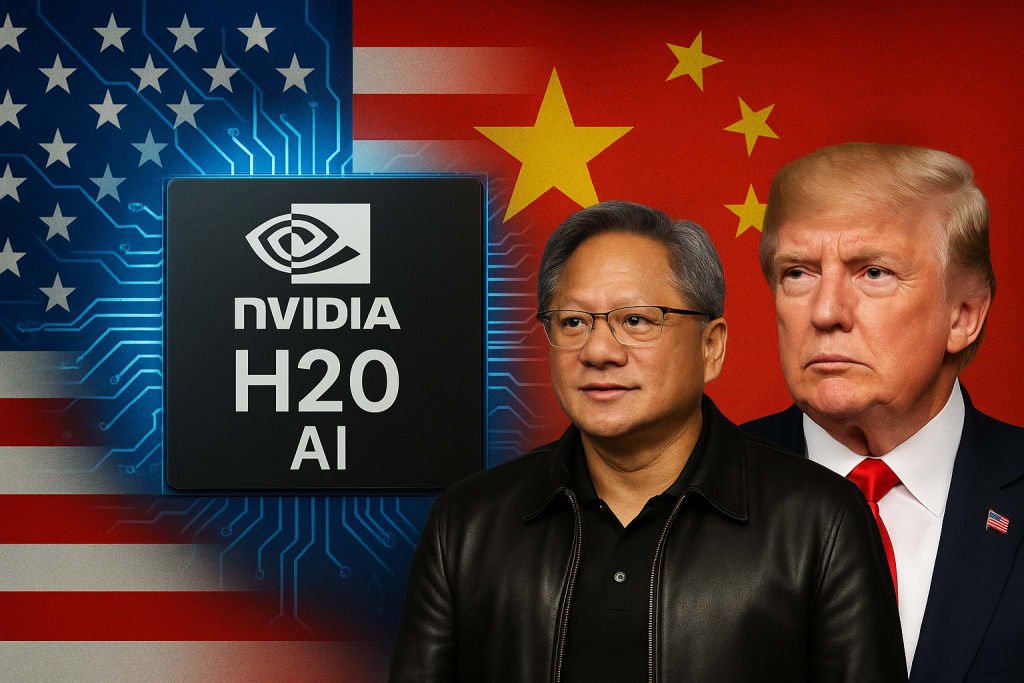





























































In a remarkable turn of events, the U.S. government, under the presidency of Donald Trump, has brokered an unprecedented agreement with tech giants Nvidia and AMD regarding the sales of their A.I. chips in China. The unique arrangement stipulates that the companies will surrender 15% of their revenue earned from their Chinese operations to the U.S. government.
This development is a significant departure from the norm in the tech industry. Typically, companies like Nvidia and AMD, which are known for their cutting-edge technology, operate independently of government intervention, especially in their international dealings. They are respected for their advanced graphics processing units (GPUs) and artificial intelligence (AI) chips, which are in high demand globally. These semiconductors play a vital role in modern technology, powering everything from personal computers and gaming consoles to data centres and supercomputers. The products of Nvidia and AMD have a wide-ranging impact on contemporary society, shaping the digital landscape and driving progress across multiple sectors.
Nvidia, a multinational tech company based in Santa Clara, California, has been a leading player in the realm of GPUs, successfully transitioning into the AI market. Its graphics processing units are renowned for their high performance and are extensively used in professional markets and the gaming industry. The company’s venture into AI and deep learning technologies has also paid dividends, as it has managed to carve out a significant market share in this burgeoning field. Nvidia’s chips are essential components in many AI applications, ranging from autonomous vehicles and robotics to cloud computing and data analytics.
On the other hand, AMD, an American multinational semiconductor company also headquartered in Santa Clara, is recognised for its central processing units (CPUs) and GPUs. Its Ryzen and Radeon product lines are celebrated for their performance and affordability, making AMD a strong competitor in both the consumer and enterprise markets. The company’s EPYC server processors and Radeon Instinct accelerators are integral to various high-performance computing and AI applications, further cementing AMD’s position in the tech industry.
China, with its vast population and rapid technological advancements, is a significant market for these tech behemoths. The demand for their products, particularly AI chips, in China is immense. This is due to the country’s ongoing digital transformation and the government’s push for AI development. China has made it clear that it intends to be a global leader in AI by 2030, and Nvidia and AMD’s technology plays a crucial role in achieving this goal.
The agreement between the U.S. government and Nvidia and AMD is a testament to the growing influence and importance of these tech companies. By securing a portion of their revenue from China, the U.S. government is acknowledging the strategic significance of AI technology and its potential economic impact. The 15% cut of revenue also underscores the geopolitical implications of the trade between the U.S. and China, as it serves as a representation of the economic leverage the U.S. holds in this technology-driven era.
However, the implications of this agreement are far-reaching, potentially affecting the dynamics of international trade and politics. It demonstrates an increased level of governmental intervention in the tech sector, a move that could set a precedent for future dealings. Moreover, it could potentially exacerbate the ongoing trade tensions between the U.S. and China, as it might be perceived as an attempt to control the technology trade.