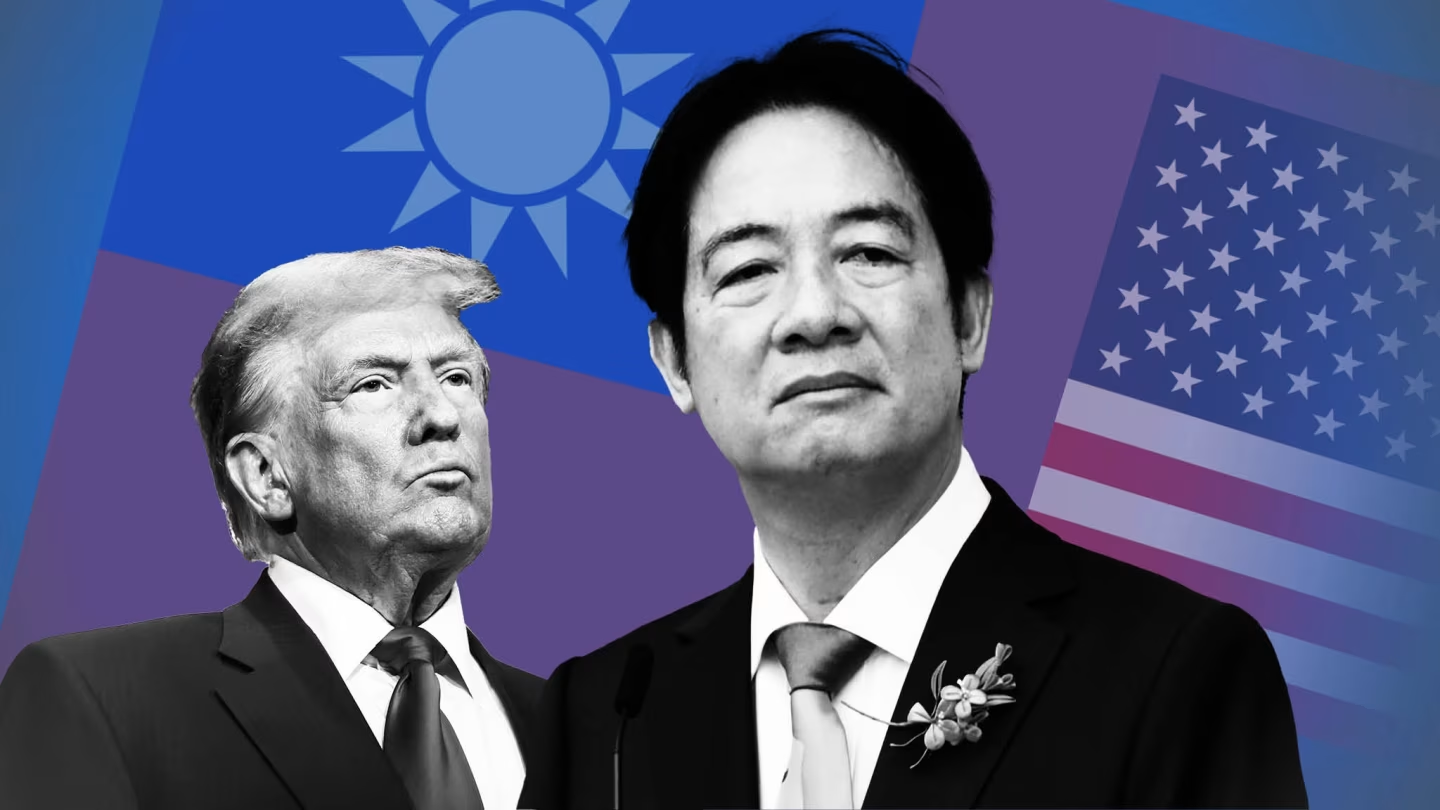

















































The cancellation of Lai Ching-te’s visit, a significant political figure in Taiwan, has brought a conspicuous silence from the Republican Party. This non-response signals a profound shift in the party’s policy towards the cross-strait relations, a matter of considerable geopolitical import.
Lai Ching-te, for the uninitiated, is an influential political figure in Taiwan. His political journey has been marked by a staunch commitment to Taiwan’s self-determination and democratic values. Thus, his visit to the United States could have represented an opportunity for the Republican Party to reinforce its traditional support for Taiwan.
Historically, the Republican Party has been a strong advocate for Taiwan, supporting the democratic island nation in its cross-strait relations with mainland China. This support is rooted in the party’s long-held belief in the principles of democracy, freedom, and human rights. In the context of Taiwan, these principles translate into the party’s support for Taiwan’s self-determination and its stance against any form of forced unification by mainland China.
The relationship between the United States and Taiwan is a delicate one, constantly under the shadow of the larger, more complex U.S.-China relationship. Despite the lack of official diplomatic ties, the United States has maintained unofficial relations with Taiwan, with the Taiwan Relations Act providing the legal basis for these interactions. The Act emphasises the United States’ commitment to assist Taiwan in maintaining its defensive capabilities against any threats. Over the years, there have been numerous instances where the Republican Party has shown its support for Taiwan by advocating for the continuous supply of defence arms and promoting Taiwan’s participation in international organisations.
Nevertheless, the party’s silence following Lai’s cancelled trip suggests a possible shift in this long-standing policy. This shift could be a reflection of the changing dynamics of the U.S.-China relationship. As the two world powers continue to navigate their strategic competition, there is a growing need to balance assertiveness with the need to avoid escalating tensions. Consequently, the Republican Party may be reassessing its approach towards Taiwan to ensure it aligns with the broader U.S. strategy.
This shift could also be indicative of the Republican Party’s recalibration of its focus in the Asia-Pacific region. Given the rise of China and its increasing influence in the region, the party may be prioritising its engagement with other Asian countries to counterbalance China’s expanding reach.
The implications of this shift, if it indeed is a shift, are significant for Taiwan. A potential reduction in U.S. support could leave Taiwan more vulnerable to pressure from mainland China. It could also impact Taiwan’s international standing, undermining its efforts to gain wider recognition and participation in global organisations.
Furthermore, this shift could also affect the United States’ credibility as a global leader. A perceived withdrawal of support for Taiwan could be seen as a deviation from the U.S.’s commitment to uphold democratic values and human rights worldwide. It could also raise questions about the U.S.’s reliability as a security partner, not only for Taiwan but also for other allies in the region.
However, it is important to note that the Republican Party’s silence on Lai’s cancelled trip does not necessarily indicate a complete about-face in its policy towards Taiwan. The party’s historical support for Taiwan remains deeply ingrained, and it could simply be a temporary recalibration in response to the evolving geopolitical landscape.
In either case, the Republican Party’s stance on Taiwan will continue to be closely watched by observers. As the party shapes its foreign policy in response to the changing dynamics of the U.S.-China relationship and the wider Asia-Pacific region, Taiwan will unquestionably remain a critical factor.
As this situation continues to unfold, the international community will be keenly watching the Republican Party’s stance towards Taiwan. The taciturn response to Lai’s cancelled trip is a stark reminder of the delicate balance that the U.S. must strike in its cross-strait policy, a balance that has far-reaching implications for Taiwan, the U.S., and the broader Asia-Pacific region.