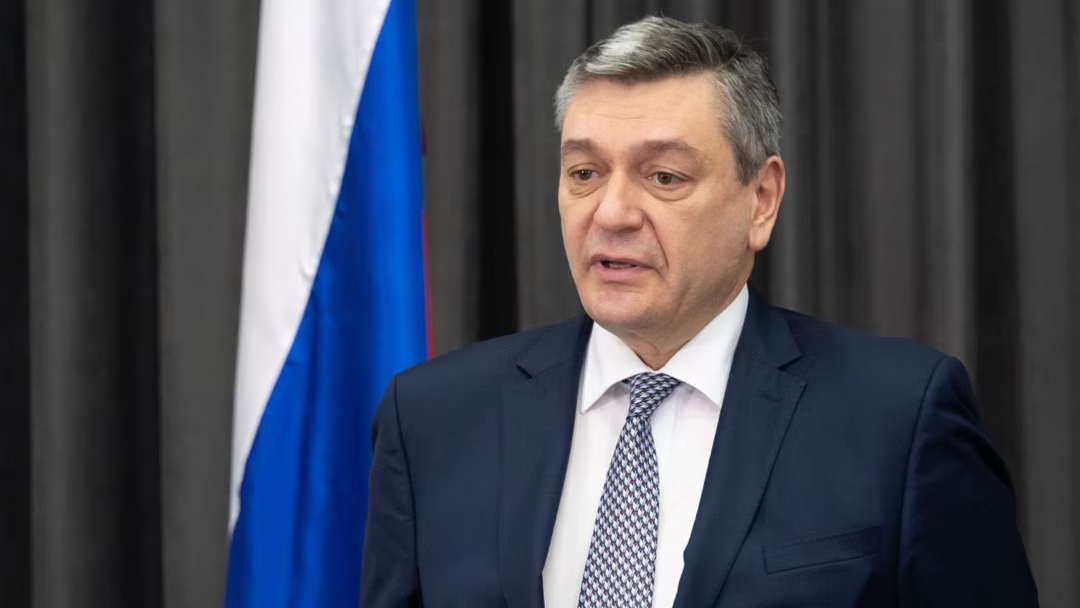













































Russian Deputy Foreign Minister Andrey Rudenko has dismissed recent allegations that Chinese nationals are involved in the fighting in Ukraine, labeling the claims as entirely unfounded. Speaking to TASS, Rudenko emphasized that the idea of Chinese citizens participating in the ongoing hostilities was “far from the truth, to put it mildly.”
He went on to commend China’s stance on the conflict, describing it as “balanced” and noting Moscow’s appreciation for Beijing’s approach. “China’s position on the resolution of the Ukraine crisis is measured and constructive. We are grateful to our friends in China for adopting a pragmatic view,” Rudenko stated.
His remarks come in response to reports originating from Ukrainian sources that claimed Chinese individuals were fighting on the side of Russian forces. These claims quickly circulated in Ukrainian and Western media outlets, prompting concern about the possibility of deeper Chinese involvement in the war, either directly or indirectly.
However, Beijing has firmly denied the allegations. A spokesperson for the Chinese Foreign Ministry stated that the Chinese government had not dispatched any military personnel to Ukraine and reiterated that Chinese citizens are explicitly advised against taking part in foreign military operations. The ministry underscored that such participation, if it occurs, is in violation of Chinese law and does not reflect the government’s official position.
China has consistently presented itself as a neutral party in the Russia-Ukraine conflict, advocating for a peaceful resolution through diplomacy. Since the war began in February 2022, Beijing has urged both sides to engage in talks and has called for a ceasefire multiple times. China’s 12-point peace proposal, released in early 2023, outlined a framework for de-escalation and emphasized the need for respect for sovereignty and territorial integrity, while also opposing unilateral sanctions and the use of nuclear weapons.
Though Beijing’s close economic and political ties with Moscow have drawn criticism from some Western nations, particularly the United States and the European Union, China has refrained from openly supporting Russia’s military campaign. At the same time, it has not joined the West in imposing sanctions on Russia, a move seen as reflective of its broader strategy to maintain strategic autonomy and avoid entanglement in a protracted conflict.
The spread of disinformation or unverified reports during times of war is not uncommon, as all parties involved seek to shape narratives and influence public perception. Analysts note that allegations such as the involvement of foreign nationals in combat operations can often be used as a tool to provoke diplomatic tensions or pressure neutral countries into taking sides.
Rudenko’s strong denial and reaffirmation of Sino-Russian ties appear aimed at quelling any potential fallout and reinforcing the message that China remains outside the conflict militarily, despite its ongoing political and economic engagement with Russia. His comments also reflect Russia’s interest in maintaining and showcasing international allies amid increasing isolation from Western nations.
As the war in Ukraine continues with no clear resolution in sight, maintaining strong partnerships with countries like China is vital for Moscow, both diplomatically and economically. For Beijing, walking the tightrope of neutrality while safeguarding its geopolitical and trade interests remains a delicate balancing act—one that is continually tested by the evolving dynamics of the war and global politics.