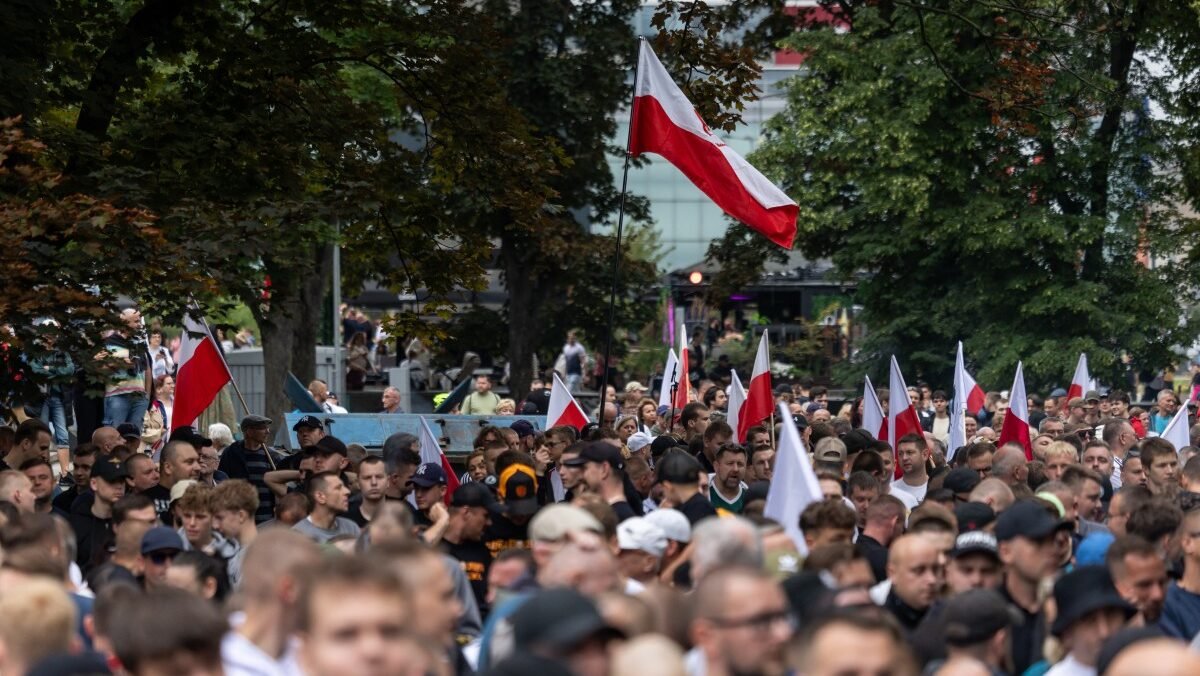





































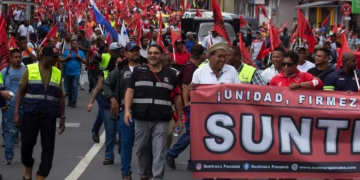










Mass anti-immigration protests erupted across Poland on Saturday, drawing demonstrators to more than 80 cities in a coordinated campaign led by the far-right Confederation Liberty and Independence party. Marches took place in major cities including Warsaw, Kraków, Poznań, Wrocław, and Białystok, where participants voiced demands for stricter border policies and called for the closure of Poland’s borders with Lithuania, Ukraine, Belarus, and Slovakia.
Krzysztof Bosak, a key figure in the Confederation party, addressed crowds in the capital, sharply criticizing the country’s current immigration strategy. “Enough of the years-long policy of ‘let everyone in, and who they are will be determined later,’” he posted on X (formerly Twitter). He insisted that Poles had legitimate concerns about national security, warning that unless Poland adopts stronger immigration controls, the safety and stability of its citizens will continue to decline.
Bosak used the platform to call for the resignation of Prime Minister Donald Tusk’s government, arguing that the administration had failed to adequately protect the nation’s borders. He controversially proposed giving security forces the authority to use firearms against individuals crossing the border illegally, and outlined a plan for mass deportations, increased surveillance of residency status, and tighter labor market controls.
The protests come shortly after the Polish government implemented new border control measures with Germany and Lithuania on July 7. These include 52 checkpoints along the German border and 13 on the Lithuanian side, introduced amid a sharp rise in irregular migration. The moves have fueled a renewed debate over the country’s migration policies and their alignment with European Union standards.
Migration has become one of the most divisive issues in Polish politics. The country has seen a surge in immigration in recent years, with tensions heightened by a long-standing crisis at its eastern border with Belarus. Since 2021, Polish and EU officials have accused Belarusian President Alexander Lukashenko of facilitating mass illegal crossings in an effort to destabilize the EU.
In response, the Polish parliament passed a law temporarily suspending asylum rights for migrants crossing from Belarus. The Interior Ministry released updated statistics showing a 40% decrease in special protection approvals for foreigners in 2024 compared to 2021, crediting the drop to improved border management and more efficient application processing. Officials framed these developments as evidence of a “responsible and well-considered migration policy” that protects both national stability and public safety.
The rise of far-right sentiment was also reflected in Poland’s recent presidential elections, where hardline candidates Sławomir Mentzen and Grzegorz Braun—both aligned with nationalist movements—finished in strong third and fourth positions. Analysts attributed their success to uncompromising stances on immigration and a wider public appetite for tougher policies.
While anti-immigration demonstrators took to the streets, counter-protests emerged in cities like Warsaw, Katowice, and Olsztyn. Organized by human rights and humanitarian organizations, these events aimed to defend the rights of migrants and asylum seekers. Participants carried signs with slogans such as “Accept the refugees, delete the fascists” and “We defend the right to asylum.” Maria Książak of the International Humanitarian Initiative Foundation emphasized that every person, regardless of their background or ethnicity, should feel safe and welcome in Europe.
The deeply polarized demonstrations highlight a growing ideological divide within Poland. On one side are those demanding more forceful national protection measures, while on the other are voices urging compassion, legality, and international responsibility in managing migration.
With elections on the horizon and nationalist momentum building, the government faces mounting pressure to respond to both domestic anxieties and international expectations. The outcome may not only reshape Poland’s migration policies, but also influence its standing within the European Union as debates over immigration intensify continent-wide.