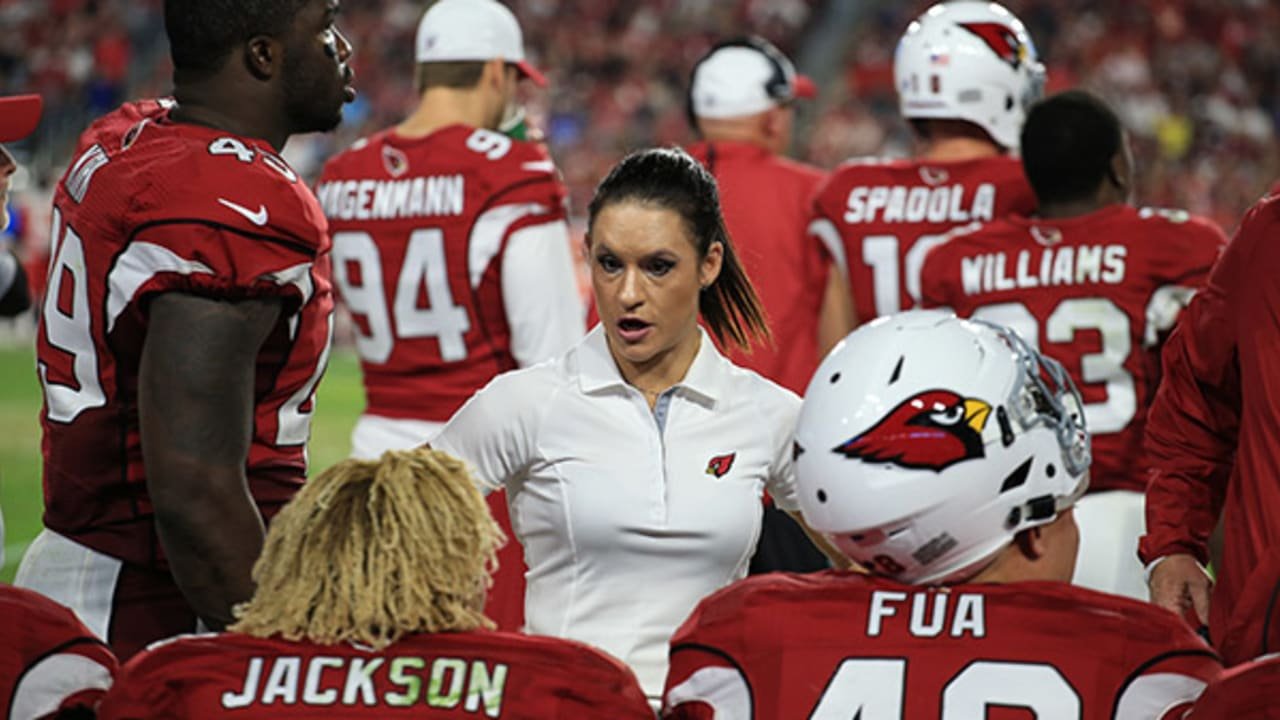




























































Ten years ago, on July 27, 2015, Jen Welter broke one of the NFL’s most enduring barriers. Hired by Arizona Cardinals head coach Bruce Arians as a training camp intern, Welter became the first woman to coach in the NFL. Her entry into the league marked a pivotal moment — one that has since triggered a slow but undeniable transformation of the football landscape for women.
Today, that spark has become a steadily growing flame. The NFL now boasts 15 women serving in full-season coaching roles and a vast number working in departments such as scouting, analytics, strength and conditioning, football operations, and training. A new generation of women in football, like Buffalo Bills assistant offensive line coach Amelia Wilson, are charting careers that were unimaginable just a decade ago.
“I got hooked on football at three, watching the Eagles with my dad,” Wilson said. “When Jen Welter got hired, it felt like someone had finally cracked open a door that had always been shut.”
When Welter stepped onto the Cardinals’ practice field in 2015, she didn’t just break into a male-dominated league — she normalized the idea that women could coach professional football players. “It was larger than life, and yet it felt so normal,” Welter recalled. “We were doing our jobs like anyone else, but to the world, it was something they had never seen.”
That visibility mattered. For young women like Wilson, who had dreamed of football beyond the stands but couldn’t envision a path, Welter’s hire offered something vital: proof of possibility.
In the years that followed, more women began appearing on NFL sidelines. Kathryn Smith became the league’s first full-time female coach in 2016 with the Buffalo Bills. Katie Sowers entered through the Falcons in 2016 and went on to coach in the Super Bowl with the 49ers. Jennifer King, now a coaching veteran, started as an intern and rose through the ranks to assistant running backs coach roles with Washington and Chicago.
By 2018, momentum was building. That year, 10 women were hired in coaching roles, tripling the numbers from just one year earlier.
The NFL’s evolving commitment to diversity — spearheaded by figures like former league executive Sam Rapoport — has helped institutionalize support for women in football. Under Commissioner Roger Goodell, league initiatives have increased hiring expectations, expanded the Rooney Rule to include women, and bolstered support for mentorship programs.
“You can see the result of intentional efforts when the leadership truly wants change,” said Rapoport, who led the NFL’s push for gender inclusion for nearly a decade.
In August 2024, the NFL reported a 187% increase in the number of women in coaching and football operations roles over the past five years. Today, every NFL team employs at least one woman in scouting or analytics, and some are making space for female strength coaches and trainers as well.
Former head coach Ron Rivera has long been a champion of female coaches. He gave Jennifer King her first opportunity and later conducted a blind résumé test to show skeptics that her credentials matched or exceeded those of male counterparts.
“It’s not about gender — it’s about whether you can help players get better,” Rivera said. “And they don’t care who you are as long as you can coach.”
That shift in perception is mirrored in team facilities too. King recalled that in Washington just a few years ago, there were barely any women using the locker room. In Chicago, however, the women’s coaching room was packed on game days — a sign of a growing workforce.
“You can feel the difference,” she said.
Beyond coaching, women like Catherine Hickman (assistant GM for the Browns) and Kelly Kleine Van Calligan (executive director of football operations for the Broncos) are edging closer to breaking another barrier: becoming the NFL’s first woman general manager.
The cultural footprint of women in football is also expanding. In 2020, Welter became the first female coach included in EA Sports’ Madden video game. By Madden 2025, female avatars, female broadcasters like Kate Scott, and enhanced coaching features were all added — a nod to the growing presence of women in football.
Meanwhile, the rise of flag football as an Olympic sport — officially added to the 2028 Los Angeles Games — is laying the groundwork for future generations. With over 65 universities fielding club or varsity women’s flag football teams, the pipeline is widening significantly.
“This will be a feeder system for coaching talent,” said Rivera. “Girls playing flag football will grow into women who understand schemes, who understand how to lead. That’s how you build a future.”
Despite the steady progress, some frontiers remain untouched. A woman has yet to be promoted from position coach to coordinator, and no woman has served as an NFL head coach. Even those closely tied to the movement — like Arians and Trask — acknowledge that such milestones may still be years away.
“There are only 32 head coaches,” Arians said. “You have to earn your stripes and prove yourself. Right now, I just don’t see many women calling plays in college football yet, and that’s part of the pipeline.”
Rapoport added that while she doesn’t expect to see a female NFL head coach in her lifetime, she is hopeful for a general manager soon.
“I’m focused on flooding the system,” she said. “If we fill the pipeline with qualified women, the cream will rise to the top.”
Welter’s impact has extended beyond the NFL. She has become a visible symbol of change in both media and gaming, and has spoken regularly on representation, equality, and inclusion in sports. Her presence helped normalize women in football for millions of viewers and players.
King saw the same in real time. The Bears’ women’s locker room was overflowing on game day — something she could barely imagine when she started. Teams have begun adapting their infrastructure with women in mind: locker rooms, facilities, and staffing accommodations are increasingly gender-inclusive.
For women to become a part of the NFL’s core culture, someone had to take the first step. Arians and Cardinals owner Michael Bidwill shared that vision and made it happen.
Welter reflected on that moment a decade later. “I think progress is never as fast as we want it, but progress is still progress, and they’ve made a heck of a lot of progress in just 10 short years,” she said. “It looks completely different than it did. And that’s a really cool retrospective to have and such a cool place to be able to say, you know what, something we did was a part of a movement that’s so special to so many people.”