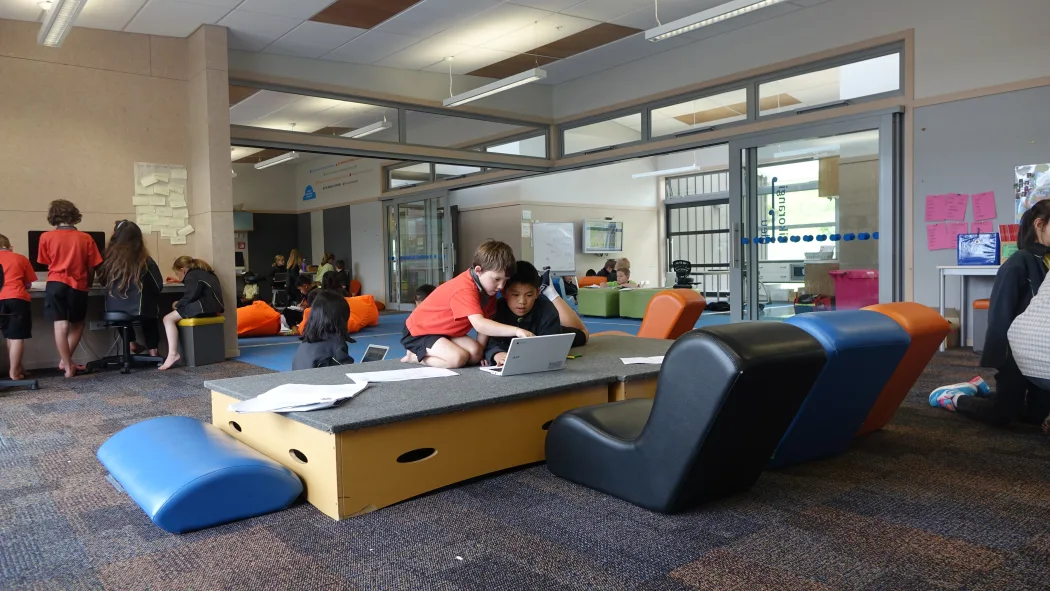
The government has confirmed it will no longer build open-plan classrooms in New Zealand schools, following extensive feedback that the design does not meet the needs of students or teachers.
Education Minister Erica Stanford announced the change on Thursday, stating that schools had provided “overwhelming” input indicating that open-plan layouts were creating more problems than solutions—particularly around managing noise levels and student behaviour.
Originally introduced in 2011 as part of the Modern Learning Environments (MLEs) initiative under the National Government, open-plan classrooms were designed to encourage collaboration and adaptability by reducing walls and combining classes and teachers into shared spaces.
However, Stanford said that in practice, these spaces often restricted flexibility rather than enhancing it.
“We have heard the concerns of educators and school leaders. From now on, all new classrooms will move away from open-plan formats,” she said.
Stanford noted that since the current government took office, no open-plan classrooms have been designed or constructed—except in cases where schools specifically requested them. Going forward, classroom designs will focus on flexibility while avoiding the fully open layouts of past MLEs.
Instead, new classrooms will incorporate features like glass sliding doors that allow spaces to be opened for group learning or closed for quiet, focused instruction. “This ensures learning spaces can adapt to different teaching approaches while still supporting student focus,” Stanford said.
The minister also highlighted cost-efficiency and sustainability as key priorities in the government’s school infrastructure programme. She revealed that the average cost of constructing a new classroom has dropped significantly—by around 28 percent—allowing the Ministry of Education to deliver more learning spaces for less.
“In 2025, we expect the average cost per classroom to be around $620,000, compared to $1.2 million at the end of 2023. That’s a major improvement that will help us deliver more classrooms, faster,” she said.
As part of a $25 million investment to manage school roll growth in the Wellington region, Stanford announced that two schools—Newlands Intermediate and Aotea College—will each receive new classroom blocks. Newlands Intermediate is set to gain 10 new classrooms, while Aotea College will receive 16.
She cited Aotea College as a case study in the shortcomings of the open-plan approach. “Their current open-plan design has proved unsuitable for teaching and learning. The layout created issues with noise and made the space less versatile for different subjects and teaching styles,” she explained.
Planning for both school upgrades is already underway, with construction expected to begin within the next 12 months.