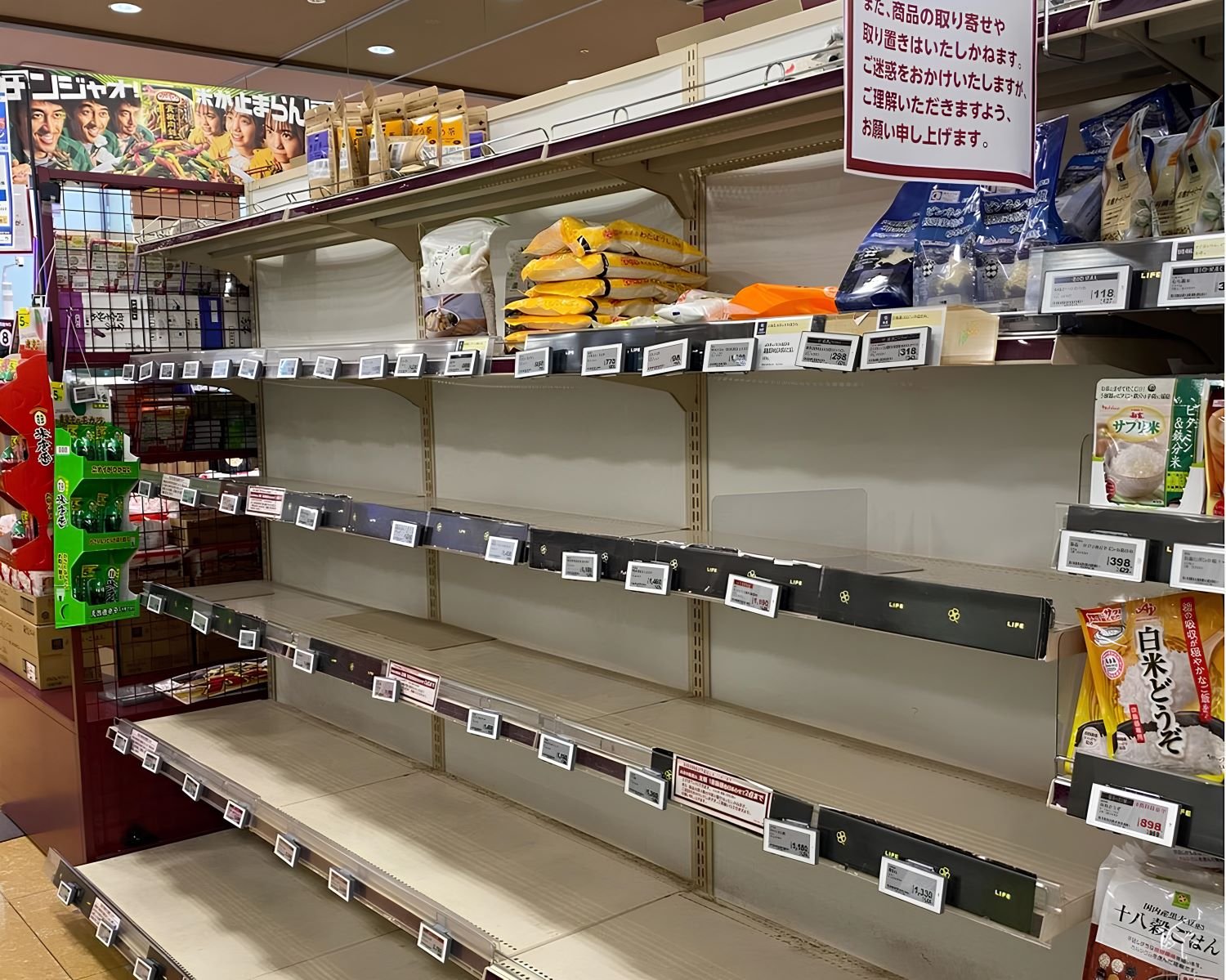





















































Japan is facing an increasingly dire rice crisis as surging prices, dwindling supply, and record heatwaves push the nation toward what farmers and analysts warn could be a food security emergency. What once seemed unimaginable in a wealthy, developed country — long lines for basic food staples — is now becoming reality.
As of May 2025, the average cost of a 5-kilogram (11-pound) bag of rice reached 4,280 yen (approximately $29), according to data from Bloomberg. That’s nearly double the price from the same period last year. Supermarkets in Tokyo and other major cities are now rationing rice sales to just one bag per household, and shelves are frequently empty. In some areas, customers reportedly begin queuing outside stores the night before — as early as 8 p.m. — just to secure a bag of rice released from government stockpiles.
The price shock stems from a cascading crisis that began in 2023, when a historic heatwave severely impacted Japan’s rice harvest. Unrelenting high temperatures disrupted pollination, reduced grain quality, and significantly lowered yields across the country’s rice-growing regions. As Japan grapples with more frequent extreme weather events linked to climate change, its traditionally stable rice supply — a cultural and dietary cornerstone — has become alarmingly fragile.
In an effort to stabilize the market, the Japanese government has begun releasing large quantities of rice from its emergency reserves. But experts warn that this strategy is unsustainable if climate conditions continue to deteriorate.
“The Japanese government has already released most of its rice reserves,” said Nobuhiko Kurosawa, a veteran rice farmer from Yamagata Prefecture, in an interview with Nikkei Asia. “If this summer turns out to be as hot as the year before last, it could be disastrous. If we have no reserves left and the quality of the rice is poor due to heat stress, Japan may have to rely on mass imports.”
Kurosawa emphasized that the implications of the crisis extend far beyond farmers and into the daily lives of every Japanese citizen. “The food problem is not just a problem for farmers — it’s a problem for everyone who eats,” he said.
The threat of rice imports also raises complex questions for Japan. The nation has historically relied on domestic rice production to ensure food sovereignty and cultural continuity. Imported rice is often seen as an inferior substitute and has struggled to gain acceptance, both in terms of taste and culinary traditions.
Beyond Japan, the crisis highlights a broader global trend: food insecurity is on the rise. Climate change, geopolitical instability, and supply chain disruptions have collectively pushed food prices upward in many regions. In the United States, the Consumer Price Index has risen 25% over the past five years, with the food index alone jumping 26%. The U.S. Department of Agriculture projects another 2.9% increase in food prices in 2025, signaling continued inflationary pressure on households.
Japan’s rice emergency underscores the vulnerability of even the most advanced economies to environmental shocks. Once considered immune to food shortages thanks to technology and trade, countries like Japan are learning that climate resilience and agricultural self-sufficiency are more critical than ever.
To mitigate future crises, Japan’s government is exploring several long-term strategies, including investment in climate-resistant rice varieties, water-efficient irrigation systems, and increased storage capacity. Efforts are also underway to promote urban agriculture and reduce food waste as part of a nationwide food security initiative.
Meanwhile, consumers are being urged to remain calm and avoid hoarding, though public anxiety continues to mount with each hot, dry day. For many, the sight of empty rice shelves and long queues is a stark reminder that the age of climate-induced scarcity is no longer a distant possibility — it’s already here.
As temperatures continue to rise and the nation heads into another unpredictable summer, the resilience of Japan’s food system — and the strength of its agricultural policy — are being tested like never before.