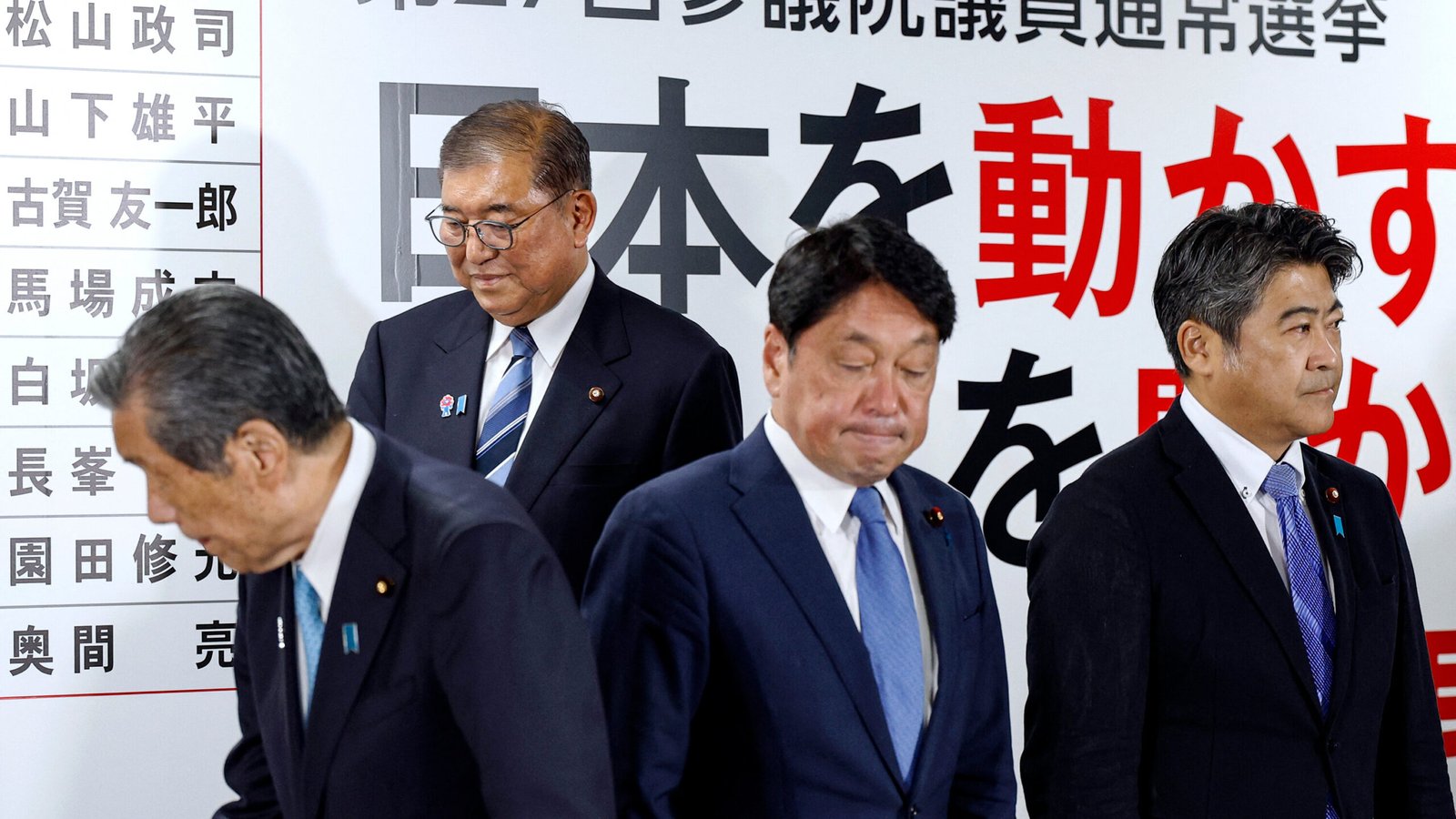





























































Japan’s Prime Minister Shigeru Ishiba has declared he will remain in office despite a bruising electoral defeat that saw the ruling coalition lose its majority in the country’s upper house. The loss compounds existing challenges facing Ishiba’s leadership, including mounting economic frustration, internal party divisions, and the growing influence of far-right political movements.
The ruling coalition—comprised of Ishiba’s Liberal Democratic Party (LDP) and its junior partner Komeito—needed to secure at least 50 seats to retain control of the 248-seat upper house. As of Sunday night, with one seat still undeclared, public broadcaster NHK reported the coalition had managed just 47 seats. Voter turnout and dissatisfaction appeared fueled by rising inflation, a sluggish economy, and anger over political scandals. Addressing reporters at the LDP headquarters in Tokyo, Ishiba acknowledged the result as “harsh” but rejected calls for resignation. He emphasized that his government’s priority remains securing favorable terms in ongoing trade talks with the United States.
Sunday’s loss follows a previous defeat in 2024, when the LDP also lost its majority in the more powerful lower house of parliament. The dual setbacks have dealt a serious blow to the coalition’s authority and triggered speculation that Ishiba’s tenure may be nearing its end. Historically, Japanese prime ministers who suffer such electoral losses step down soon after; the last three LDP leaders to lose the upper house majority resigned within two months of the vote.
Analysts point to the rise of the far-right Sanseito party as a major factor in the LDP’s weakened performance. Sanseito has gained traction among disenchanted conservatives, many of whom believe Ishiba is too moderate compared to former Prime Minister Shinzo Abe, who held a more nationalistic and hawkish stance. Political analyst Jeffrey Hall, from Kanda University of International Studies, told the BBC that Ishiba is viewed by many traditional LDP supporters as lacking the ideological conviction and patriotism they associate with Abe’s legacy. He added that Sanseito is voicing views that were previously avoided in mainstream Japanese politics, including conspiracy theories, historical revisionism, and openly anti-foreign sentiment.
Founded during the COVID-19 pandemic, Sanseito rose to prominence via social media by spreading misinformation about vaccines and promoting nationalist slogans like “Japanese First.” Their rhetoric resonated with voters concerned about immigration and perceived cultural dilution. Japan, long known for its strict immigration controls and homogenous society, has experienced a surge in both tourists and foreign residents in recent years. Some Japanese citizens have blamed the influx for rising housing and food costs, especially the soaring price of rice.
Ishiba’s critics within the LDP argue that he failed to respond forcefully to these public concerns. His technocratic leadership style has done little to inspire confidence in a time of economic strain, and scandals involving party members have further eroded public trust. The defeat has opened the door to possible leadership challenges. Among the potential successors are Sanae Takaichi, a nationalist conservative who previously ran against Ishiba for party leadership; Takayuki Kobayashi, a former minister of economic security; and Shinjiro Koizumi, a young reformist and son of former Prime Minister Junichiro Koizumi.
Despite the mounting pressure, Ishiba insists on staying the course. His resolve may partly stem from a desire to maintain stability during sensitive trade negotiations with the United States. However, his grip on power is far from secure. Recent policy moves indicate Ishiba is attempting to court the nationalist base. Last week, he announced the launch of a government task force aimed at cracking down on crimes and “nuisance behaviors” attributed to some foreign residents. The initiative includes reviewing immigration violations, land acquisitions by foreigners, and unpaid social insurance contributions. Critics argue this effort risks legitimizing xenophobic sentiment and diverting attention from deeper systemic issues such as wage stagnation and demographic decline.
Ishiba’s announcement has sparked concern among rights groups, who fear it may encourage discrimination against Japan’s growing foreign population. However, the move may succeed in temporarily placating far-right factions and conservative voters frustrated by what they perceive as the LDP’s drift from its traditional values.
As Japan navigates this turbulent political landscape, the country stands at a crossroads. The erosion of the LDP’s once-unshakable dominance signals growing volatility in Japanese politics. With economic pressures mounting and nationalist movements gaining momentum, Ishiba’s leadership will be tested like never before. Whether he can weather the storm and hold his coalition together—or become the latest in a long line of Japanese prime ministers to fall under the weight of political disappointment—remains uncertain.