













































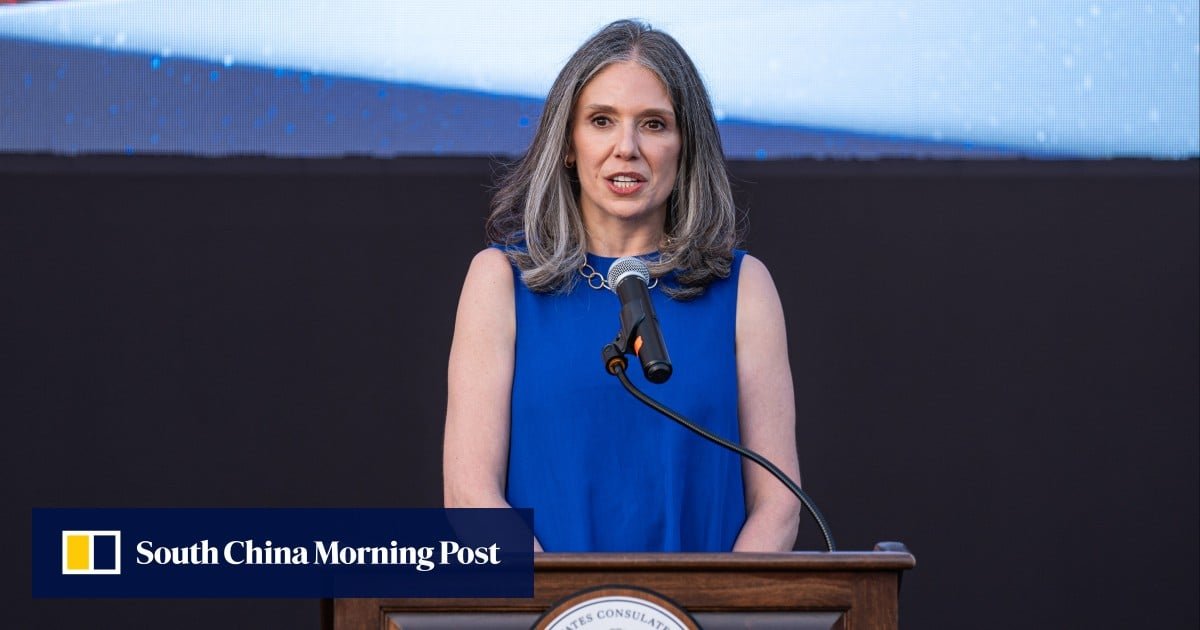
**New US Consul General Julie Eadeh Arrives in Hong Kong Following Beijing’s Approval**
Julie Eadeh, a seasoned diplomat with a distinguished career in the US Foreign Service, has officially taken up her role as the new US Consul General in Hong Kong. Her appointment comes after receiving the necessary approval from Beijing, a standard diplomatic procedure under the Vienna Convention on Consular Relations, which mandates that top diplomats, including ambassadors and consuls general, secure the host nation’s agreement before commencing their duties.
Eadeh succeeds Gregory May, who recently departed Hong Kong to take on the role of deputy chief of mission at the US embassy in Beijing. Her arrival marks a significant moment in US-Hong Kong relations, particularly given the backdrop of heightened tensions between the United States and China over various geopolitical issues.
Eadeh is no stranger to the complexities of diplomacy in politically sensitive regions. She has served in various capacities within the US State Department, bringing a wealth of experience to her new position. Her career has included assignments in the Middle East and Asia, where she has navigated challenging diplomatic landscapes. Her expertise will be crucial in managing the intricate dynamics of US-Hong Kong relations, especially as the city continues to grapple with the implications of China’s national security law, which was imposed in 2020.
Her appointment comes at a time when Hong Kong is undergoing significant political and social changes. The city has been a focal point of international attention, particularly since the 2019 pro-democracy protests, which saw millions of residents take to the streets. These demonstrations were sparked by a controversial extradition bill and evolved into a broader movement demanding greater democratic freedoms and autonomy from mainland China.
Eadeh herself was embroiled in controversy during the 2019 protests. Photographs emerged of her meeting with opposition activists, which led to accusations from pro-Beijing media and officials of foreign interference in Hong Kong’s affairs. The incident underscored the delicate nature of diplomatic engagements in the city and highlighted the challenges faced by foreign diplomats operating in such a charged environment.
The role of the US Consul General in Hong Kong is particularly significant given the city’s unique status. Although Hong Kong is a Special Administrative Region of China, it maintains a separate legal and economic system under the “one country, two systems” framework. This arrangement was intended to preserve Hong Kong’s way of life and autonomy for 50 years following its handover from British to Chinese sovereignty in 1997. However, recent developments, including the implementation of the national security law, have raised concerns about the erosion of these freedoms.
The national security law, which criminalises acts of secession, subversion, terrorism, and collusion with foreign forces, has been criticised by Western governments, including the United States, as a tool for suppressing dissent. It has led to the arrest of numerous pro-democracy activists and politicians, prompting international condemnation and sanctions from the US and its allies.
In this context, Eadeh’s role will involve not only managing the day-to-day operations of the consulate but also advocating for US interests and values in Hong Kong. This includes promoting human rights and democratic principles, as well as supporting American businesses and citizens residing in the city.
The US Consulate in Hong Kong is one of the largest American diplomatic missions in the world, reflecting the importance of the city as a global financial hub and a gateway to China. The consulate’s work encompasses a wide range of activities, from issuing visas and providing consular services to facilitating trade and investment between the US and Hong Kong.
Eadeh’s appointment also comes amid ongoing trade tensions between the US and China, which have affected global markets and supply chains. The two countries have been engaged in a protracted trade war, characterised by tariffs and counter-tariffs on billions of dollars’ worth of goods. While there have been efforts to reach a trade agreement, significant differences remain, particularly in areas such as technology and intellectual property rights.
Furthermore, the geopolitical rivalry between the US and China extends beyond trade. It encompasses issues such as cybersecurity, military presence in the Asia-Pacific region, and influence in international organisations. Hong Kong, with its strategic location and status as a major financial centre, is inevitably caught in the crossfire of this great power competition.
Eadeh’s diplomatic acumen will be essential in navigating these challenges and maintaining open lines of communication between the US and Hong Kong. Her previous experience in the region, including her work in the Middle East, has equipped her with the skills necessary to engage with a diverse range of stakeholders, from government officials to civil society groups.
As she begins her tenure, Eadeh faces the task of rebuilding trust and cooperation in a city that has been deeply affected by political turmoil and external pressures. Her ability to balance the interests of the US with the realities of Hong Kong’s evolving political landscape will be critical in shaping the future of bilateral relations.
While the US State Department has not provided an official comment on Eadeh’s appointment, her presence in Hong Kong signifies a continued commitment to engaging with the city and supporting its unique status. As the world watches closely, Eadeh’s leadership will be instrumental in navigating the complexities of US-Hong Kong relations in the years to come.