
























































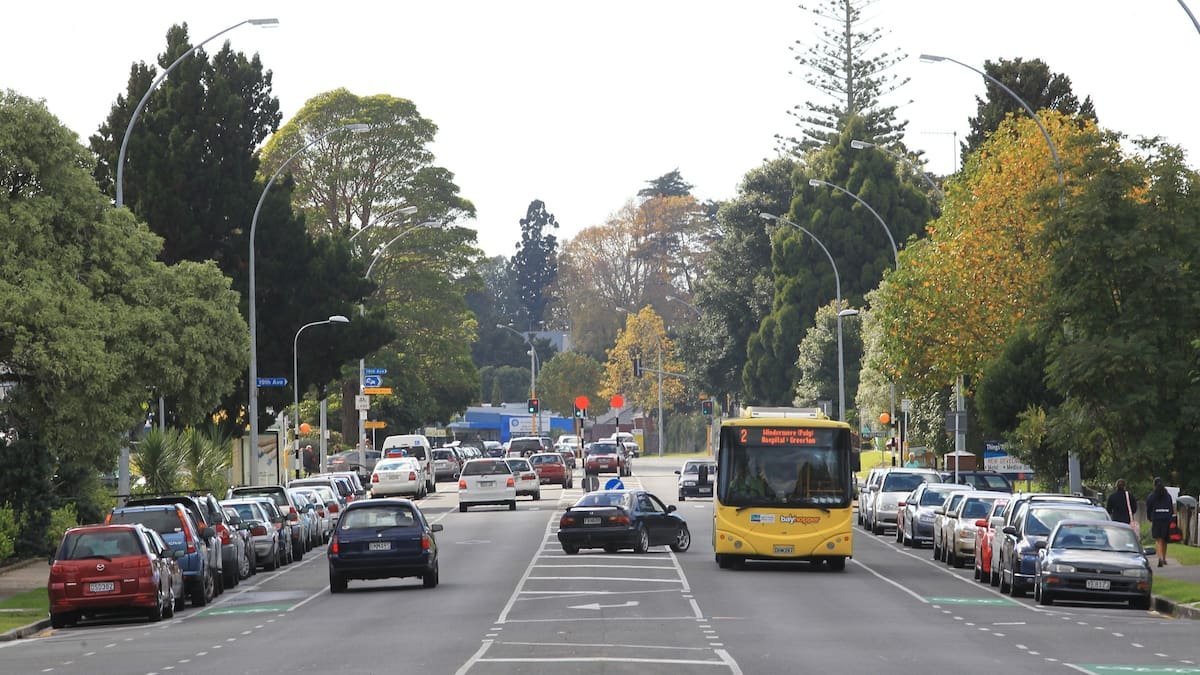
A significant road development in Tauranga is poised to proceed without financial support from the New Zealand Transport Agency (NZTA), necessitating certain compromises in the project’s scope. The Cameron Road Stage 2 initiative involves the expansion of the southern portion of this central arterial route to four lanes, extending from 17th Avenue to Maleme Street. In addition to the road expansion, the project includes an upgrade of the water infrastructure beneath the road, with local ratepayers expected to shoulder over $100 million of the total costs.
This project follows the contentious $110 million Cameron Road Stage 1, which concentrated on the northern section and concluded in early 2024. Initially, Tauranga City Council had intended to co-finance Stage 2 with the NZTA. However, the project did not receive prioritisation in the current National Land Transport Programme, prompting the council to explore alternative funding strategies.
During a recent council meeting, councillors were presented with a revised “value for money” proposal. The original plans for the transport infrastructure were estimated at $164 million, but the revised design is projected to cost $98.8 million. This funding could potentially be sourced from a $56.4 million grant from the Government’s Infrastructure Acceleration Fund (IAF), $22.4 million in developer contributions, and $20 million from an Infrastructure Funding and Financing Levy, which ratepayers would repay through a targeted rate.
The necessary $86.7 million for water infrastructure is covered under the current long-term plan. Consequently, ratepayers will be responsible for at least $106.7 million of the project’s total cost, with the IAF grant still not guaranteed. The IAF is under review, posing a risk to this funding source. However, the fund administrator indicated that if the council commits to completing the project by 30 June 2030, the likelihood of retaining the funding may increase.
Richard O’Kane, the council’s senior project manager, acknowledged that the proposed designs entail compromises and trade-offs. One significant challenge is facilitating right turns along the route, while another involves the beautification of the berms and urban revitalisation. The original design included new footpaths with pavers, signage, and beautification similar to Cameron Road Stage 1, but the new design prioritises transport outcomes.
Three concept design options have been devised for Greerton Village. Option 1 proposes four lanes along the entire route with dual signalised intersections in Greerton Village, estimated to cost $95.4 million. Option 2 suggests two lanes through the village with separated cycle lanes, with an estimated cost of $88 million. Option 3 envisions four lanes along the entire route with dual roundabouts in Greerton Village, at an estimated cost of $90.8 million.
The four-lane options aim to futureproof the corridor, allowing for dedicated bus or transit lanes that could be converted into parking spaces outside peak traffic hours. The existing corridor currently accommodates approximately 338 on-street parking spaces, and initial assessments suggest that 300 could be retained under the new design. Modelling indicates that the four-lane option is the most favourable outcome.
The council plans to present these options to the community for feedback, which will be incorporated into further design iterations. O’Kane emphasised the project’s importance in facilitating housing intensification on the Te Papa peninsula, which is crucial for the city’s growth objectives. The IAF funding agreement is contingent upon accelerating infrastructure development to enable at least 1,600 additional dwellings in the Te Papa area over the next decade.
Mayor Mahé Drysdale described the revised plan as a “suboptimal solution” but noted that it would deliver tangible outcomes in the near term. He warned that without action, the council might still be discussing the project a decade from now, with costs potentially ballooning to $300 million. “If we want to deliver a project, this is our best opportunity to do so,” Drysdale stated. While the revised plan may not include all the “nice-to-haves” from the original proposal, it is expected to achieve the same outcomes at roughly half the cost.
Councillor Glen Crowther expressed support for the project but cautioned that the timeline for completion is “very tight.” He stressed the importance of ensuring that the council does not incur undue risks and costs that have not been accounted for in the project. Crowther noted that there were “big learnings” from Stage 1, where recognised risks were not addressed early enough, leading to delays, budget overruns, and significant disruption, particularly for businesses along Cameron Road.
Crowther also emphasised the need for genuine public engagement on key issues related to the project. The council unanimously agreed to commit to delivering the project. Once confirmation of the IAF funding is received, concept designs will be released for public feedback. A report is expected to be presented to the City Future Committee in 2026 to finalise the design before detailed planning commences.
The Cameron Road Stage 2 project is part of a broader strategy to address Tauranga’s infrastructure needs as the city continues to grow. Tauranga, located in the Bay of Plenty region, is one of New Zealand’s fastest-growing urban areas, with a population that has been steadily increasing over the past decade. This growth has put pressure on existing infrastructure, necessitating significant investments in transport and housing to accommodate the expanding population.
The NZTA’s decision not to prioritise the project in the current National Land Transport Programme reflects broader challenges in funding infrastructure projects across New Zealand. The agency is tasked with balancing competing demands for funding across the country, with a focus on projects that deliver the greatest benefits in terms of safety, access, resilience, and environmental sustainability.
The Infrastructure Acceleration Fund, part of the government’s broader efforts to address housing shortages, aims to unlock land for housing development by funding the necessary infrastructure. The fund is designed to accelerate the delivery of housing by providing financial support for projects that might otherwise be delayed due to funding constraints.
As Tauranga City Council moves forward with the Cameron Road Stage 2 project, it will need to navigate the complexities of securing funding, managing public expectations, and delivering a project that meets the city’s long-term needs. The outcome of this project will have significant implications for Tauranga’s future growth and development, as well as for the residents and businesses that rely on this critical transport corridor.