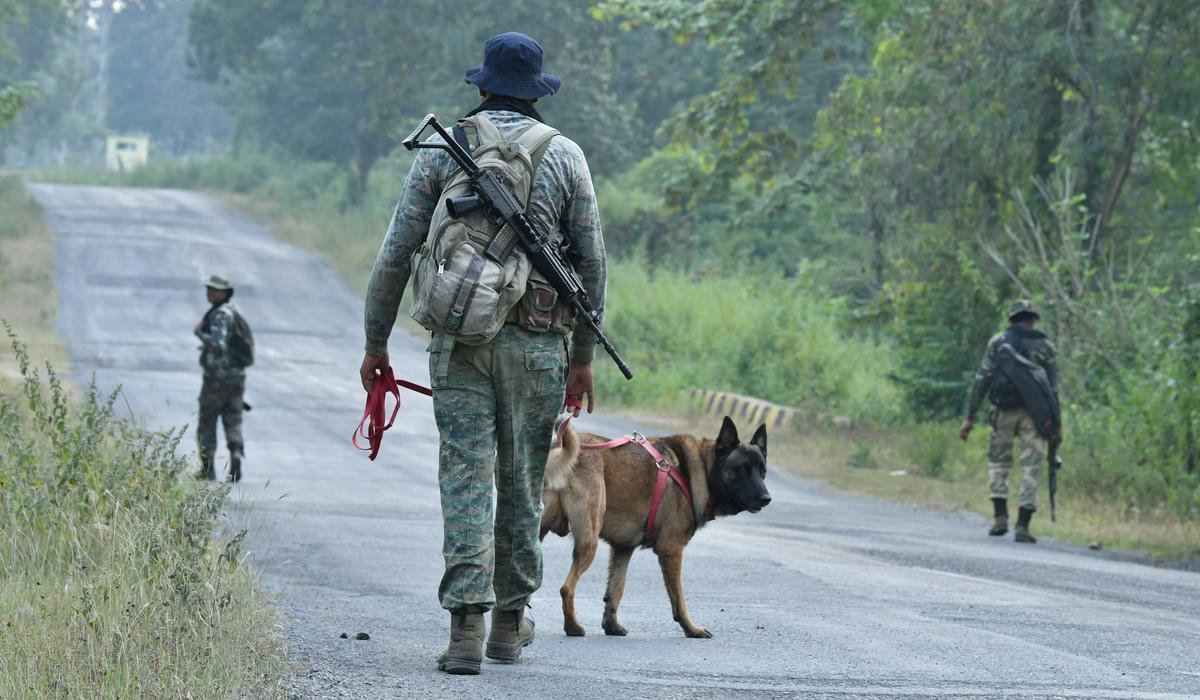





























































Six Maoists were killed on Friday in a fierce gun battle with security forces deep inside the dense and strategically sensitive Abujhmad region of Narayanpur district, Chhattisgarh. The encounter marks yet another major success in India’s ongoing crackdown against Left-Wing Extremism (LWE), particularly in the red corridor areas of Bastar division.
The operation, which began early Friday afternoon, was based on specific intelligence about the presence of armed Maoist cadres in the remote jungles of Abujhmad—an area known for its rugged terrain and Maoist activity. A coordinated team consisting of personnel from the District Reserve Guard (DRG), Special Task Force (STF), and Central Reserve Police Force (CRPF) launched a combing and search mission to flush out the insurgents.
During the mission, multiple rounds of fire were exchanged between the Maoists and security personnel at an undisclosed location. The clash continued intermittently before the forces were able to neutralize six Maoist operatives. Among the recovered items were high-powered weapons including an AK-47 rifle and a Self-Loading Rifle (SLR), indicating that the group may have included mid-to-senior-level Maoist commanders.
Inspector General of Police (Bastar Range), Sundarraj P, confirmed the development. “The bodies of six Maoists have been recovered. The identification process is currently underway. Weapons, ammunition, and other materials were also seized from the site,” he said, adding that further details will be shared after the conclusion of the ongoing operation.
Security officials have withheld the exact location of the encounter to ensure the safety of personnel, as the region remains a high-risk zone with the potential for ambushes or retaliatory attacks.
This latest encounter brings the number of Maoists killed in Chhattisgarh so far this year to 221, with 204 deaths reported from the Bastar region alone—a sharp rise compared to the same period last year, when 219 were killed across the state, including 217 from Bastar.
The uptick in successful operations reflects an intensified security push in Maoist-affected districts, in line with the central government’s pledge to eliminate the Maoist threat by March 2026.
In June, Union Home Minister Amit Shah visited Chhattisgarh to assess the progress of anti-Maoist operations. During his visit, Shah delivered a public address underscoring the government’s resolve to eradicate LWE. “Every year during the monsoon, Naxals used to get some rest. But this time, we won’t let them rest even during the rains,” he said. “We are committed to achieving our target of eliminating Maoism from the country by March 2026.”
Abujhmad, a vast and largely uncharted forested area spanning parts of Narayanpur, Bijapur, and Dantewada, remains one of the most significant strongholds of Maoist activity in central India. The region, lacking basic infrastructure like roads and communication networks, has long served as a safe haven for insurgents. The government’s renewed push includes not only military operations but also parallel development efforts aimed at integrating these regions with the mainstream.
While the recent encounter is being hailed as a success, security officials remain cautious. Sources indicate that several Maoist cadres may have escaped during the encounter, and combing operations are continuing in adjacent forest areas.
As operations intensify, authorities have urged villagers in surrounding areas to remain vigilant and report any suspicious activity. The state government, in cooperation with the Centre, has pledged continued support for infrastructure development and de-radicalization initiatives in the Bastar region, which has historically suffered from underdevelopment and insurgent violence.
The successful operation in Abujhmad is a testament to the evolving strategy of India’s counter-insurgency forces: a combination of precise intelligence, improved logistics, and constant pressure on Maoist supply lines and hideouts.