
























































**New Surveys Reveal Stark Partisan Divide Over Trump’s Crime Strategy**
Two recent surveys have unveiled a significant partisan divide regarding the federal government’s role in addressing crime in American cities. This division emerges despite a substantial portion of the population viewing urban crime as a pressing issue. A Reuters/Ipsos poll, released on Tuesday, indicates that only 36% of Americans are in favour of “federal officials bringing the Washington, DC local police under federal control citing a public safety emergency.” Similarly, 38% support “deploying National Guard troops from other states to Washington, DC, for law enforcement efforts.” Among these respondents, Republicans are the most supportive, with 76% endorsing National Guard deployments in the capital and 71% backing federal control of the city’s local police. In stark contrast, a mere 8% of Democrats support either measure.
The debate over federal involvement in local policing extends beyond Washington, DC. An AP-NORC survey, published on Wednesday, reveals that a majority of Americans find it acceptable for the federal government to “use the US military and National Guard to assist local police.” Approximately 55% of respondents consider this at least somewhat acceptable, although only 26% deem it “completely acceptable.” Meanwhile, 37% regard it as somewhat or completely unacceptable. However, the notion of the federal government taking control of local police departments is largely opposed, with 55% of respondents viewing it as very or somewhat unacceptable, while 32% find it at least somewhat acceptable.
The partisan divide is evident in these findings as well. Among Republicans, 82% view the use of the military and National Guard as acceptable, compared to 46% of independents and 30% of Democrats. Regarding the takeover of local police forces, 51% of Republicans find it acceptable, in contrast to 26% of independents and a mere 15% of Democrats.
The AP-NORC poll also highlights widespread concern about crime in the United States. A significant majority of Americans (81%) perceive crime as a major problem in large cities, with 66% considering it a major issue for the country as a whole. In contrast, far fewer individuals express similar concerns about their own communities (24%) or small towns and rural areas (20%).
These surveys come amidst a broader national conversation about crime and public safety, issues that have been thrust into the spotlight by high-profile incidents and political rhetoric. The question of federal intervention in local policing has been a contentious topic, with proponents arguing it is necessary to address escalating crime rates, while opponents warn of the potential erosion of local autonomy and civil liberties.
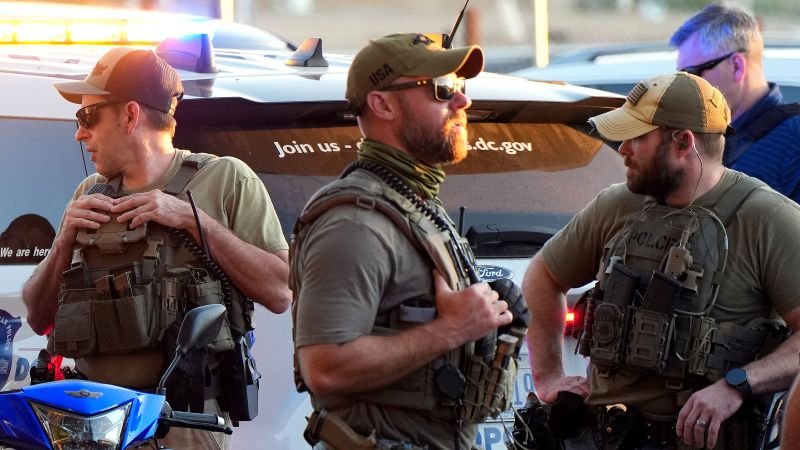
President Donald Trump’s approach to crime, particularly in Washington, DC, has been a focal point of this debate. Despite the deployment of federal agents in the capital, these actions appear to have had little impact on his overall approval ratings. According to a CNN Poll of Polls conducted in August, Trump’s approval rating stands at an average of 41% approval against 56% disapproval, figures that have remained relatively stable throughout the summer.
When it comes to his handling of crime specifically, public opinion is mixed. The Reuters/Ipsos poll and a new Strength in Numbers/Verasight poll both report approval ratings below 50% for Trump’s crime policies, with 43% and 45% approval, respectively. However, the AP-NORC poll presents a more favourable view, with 53% of respondents approving of Trump’s handling of crime and 45% disapproving. Across these polls, Trump’s management of crime remains one of his stronger areas of issue approval.
The AP-NORC poll was conducted from August 21 to 25, surveying a random nationwide sample of 1,182 adults, with a margin of sampling error of plus or minus 3.8 percentage points. The Reuters/Ipsos poll took place from August 22 to 24, involving 1,022 adults and a margin of error of plus or minus 3.0 points. The Strength in Numbers/Verasight poll was conducted from August 18 to 21, surveying 1,500 adults with a margin of error of plus or minus 2.6 points. All three surveys were conducted online.
The current discourse on crime and federal intervention is set against a backdrop of broader societal concerns. The United States has witnessed a series of high-profile incidents that have intensified public scrutiny of crime and law enforcement. These events have sparked debates about the balance between ensuring public safety and safeguarding civil liberties, a conversation that continues to evolve as new incidents unfold.
In recent years, crime rates in major US cities have fluctuated, with some areas experiencing spikes in certain types of crime. This has led to increased calls for intervention and reform, both at the local and federal levels. The role of the federal government in local policing has been a contentious issue, with historical precedents offering both cautionary tales and examples of effective collaboration.
The deployment of federal forces in Washington, DC, and other cities has drawn comparisons to past instances of federal intervention, such as during the civil rights movement in the 1960s. These historical examples highlight the complexities and potential consequences of federal involvement in local affairs, underscoring the importance of balancing immediate security needs with long-term community trust and cooperation.
As the nation grapples with these challenges, the political landscape remains deeply divided. The partisan split over crime and federal intervention reflects broader ideological differences that have come to define American politics in recent years. These divisions are likely to play a significant role in shaping the discourse and policy decisions in the lead-up to the 2024 presidential election.
In the meantime, the conversation around crime and public safety continues to evolve, influenced by ongoing developments and the diverse perspectives of stakeholders across the political spectrum. As policymakers and citizens navigate these complex issues, the search for effective and equitable solutions remains a pressing priority for communities across the United States.