

















































Honduras has emerged as the second-most affected country in Central America by informal employment, with an alarming 82.6% of its workforce engaged in jobs outside the formal economy. This revelation, outlined in the latest Regional Competitiveness Bulletin by the Honduran Council of Private Enterprise (Cohep), highlights deep-rooted labor market challenges in the region.
Only Guatemala surpasses Honduras in informality, recording an 83.2% rate. In stark contrast, countries such as Costa Rica and the Dominican Republic report significantly lower informality levels—37.4% and 54.7%, respectively. El Salvador (66.5%), Nicaragua (63%), and Panama (58.7%) fall in the mid-range but still reflect widespread informal labor dependence across the region.
According to Cohep’s report, informal employment remains one of the most serious impediments to economic productivity and social development in Central America. Millions of people are compelled to work in informal sectors not by preference, but due to the chronic shortage of quality job opportunities in the formal economy.
“Eight out of every ten workers in Honduras and Guatemala operate in the informal sector—not by choice, but by necessity. This reflects a failure of our public policies to generate real employment alternatives,” said Alejandro Kaffati, Cohep’s Economic Policy Officer. “Changing this must be at the center of national development strategies.”
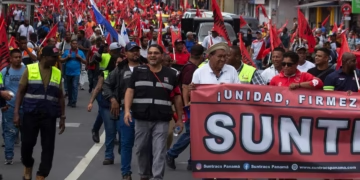
Informal work—defined as employment that is not regulated or protected by the state—includes a wide range of low-paid, unregulated jobs often devoid of legal safeguards such as social security, health benefits, job contracts, and labor rights. This type of employment typically exposes workers to job insecurity, poor working conditions, and greater vulnerability to economic shocks.
The bulletin also links high informality to broader economic underperformance. In 2024, Central America and the Dominican Republic achieved a combined Gross Domestic Product (GDP) of $498 billion, marking a regional growth rate of just 2.8%, according to data from the Economic Commission for Latin America and the Caribbean (ECLAC).
Despite being among the region’s most populous nations, Honduras, El Salvador, and Nicaragua contributed only 4% to 7% of this GDP total. Kaffati emphasized that these nations must urgently focus on stimulating domestic growth by enhancing education, supporting entrepreneurship, and formalizing employment across key sectors.
Informality also poses structural challenges to national governments. As fewer workers pay income tax or contribute to social security, public revenues dwindle. This severely restricts the state’s ability to fund social programs, invest in infrastructure, and support formal enterprises. In turn, it undermines the stability and competitiveness of the formal business sector.
“This is not just a labor issue—it’s a national development issue,” said Kaffati. “Widespread informality weakens public institutions, erodes fiscal capacity, and deprives millions of people of the social safety nets they deserve.”
Experts suggest that addressing informality requires a multi-pronged approach. Recommendations include easing business registration processes, reducing bureaucratic and tax burdens on small enterprises, improving access to credit, and expanding vocational training and education. Crucially, there is also a need to align labor market reforms with the realities of informal workers, many of whom operate as street vendors, domestic workers, or informal contractors in agriculture and construction.
For Honduras, which has long struggled with poverty, high youth unemployment, and social instability, the issue of informality underscores a more profound economic vulnerability. According to the World Bank, over 50% of the Honduran population lives in poverty, and the informal economy has become a survival mechanism for much of the workforce.
Cohep’s bulletin calls for coordinated action between the public and private sectors, civil society, and international partners to reverse the informality trend. “Reducing informal employment is not a short-term goal—it’s a long-term mission that requires political will, strategic investment, and sustained social dialogue,” the report concludes.
As the country grapples with this crisis, policymakers are being urged to recognize informal workers not as marginal economic actors, but as central stakeholders in Honduras’ path toward inclusive and sustainable development.