
























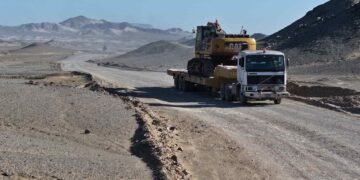



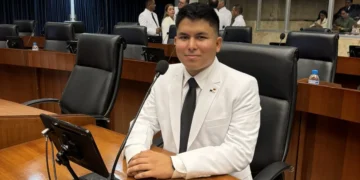

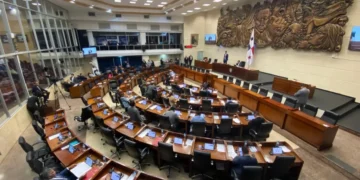








Political tensions in Guatemala escalated sharply this week when Deputy Luis Aguirre threw a tire across a table during a congressional hearing with Minister of Communications Miguel Ángel Díaz. The symbolic act of protest, which was in response to deteriorating road conditions, took place during a session of the Cabal party bloc and was widely shared on social media.
President Bernardo Arévalo’s administration has confirmed that it will not pursue administrative or legal action against Aguirre following the incident. This stands in contrast to previous governments, such as those of Jimmy Morales and Alejandro Giammattei, which often took legal routes to confront mounting congressional pressure.
Aguirre, head of the Cabal party bench, delivered his protest by placing the tire in front of Minister Díaz as a direct accusation of neglect. Political analyst Renzo Rosal argued that this was not a spontaneous outburst but a calculated move intended to send a clear message. He warned that congressional opposition to the executive would likely intensify moving forward, and that the lack of a forceful response from the presidency could embolden similar acts.
Despite Aguirre’s apology, Rosal noted that the real impact of the act was political—signaling not only to his own party but also to other opposition groups that aggressive tactics are fair game. Rosal stated that this reflects a new stage of heightened political pressure on the executive branch.
While legislative summonses and interpellations are constitutional tools for oversight, Rosal criticized how these sessions are increasingly being used for political theater rather than policy scrutiny. He said that vague or loosely defined topics have become common in hearings, preventing ministers from preparing adequately and turning the sessions into media spectacles. This shift, he said, dilutes the original purpose of accountability and risks eroding institutional credibility.
He also noted that many government officials arrive at hearings underprepared and lack political defense, making them easy targets. The absence of a strong bench to represent the executive in Congress further weakens their position. According to Rosal, this passivity invites more confrontations and damages the dignity of public office.
Rosal emphasized that this week’s incident should have prompted a firmer institutional response. By not taking a clear stance, the government missed an opportunity to draw boundaries and maintain decorum. The need for executive officials to assert themselves with more authority and strategic communication has never been more pressing, he said.
The incident also sheds light on the sheer volume of legislative scrutiny facing the administration. From January 2 to July 22, 2025, a total of 997 summonses were issued by lawmakers to members of the executive branch. The most active months were February with 187 and March with 160 summonses. The political parties behind most of these calls include UNE (172), VOS (162), Vamos (108), and Cabal (93).
Among government ministries, the Ministry of Public Health and Social Assistance has been summoned the most—207 times—followed by the Ministry of Communications (145) and the Ministry of Education (141). In total, 26 executive institutions have been called to hearings multiple times this year.
Past administrations have also struggled with these confrontations. In 2016, President Jimmy Morales vetoed a law that imposed prison terms on ministers who failed to appear at congressional hearings. Congress overruled the veto, leading Morales and his cabinet to avoid direct appearances, often citing scheduling conflicts. This avoidance led to increasing friction with the legislature.
In 2022, Alejandro Giammattei took the matter to the Constitutional Court to seek clarification on the limits of congressional summonses. The court provided some guidelines, but no major changes followed, and the power struggle continued.
Political analyst Rosal concluded that the current administration faces a uniquely vulnerable position. Without a loyal congressional bloc or a robust strategy for navigating summonses, officials are exposed to public criticism and legislative ambushes. This vacuum of political support only increases the likelihood of future confrontations like the one sparked by Deputy Aguirre’s protest.
The administration’s challenge now is to reclaim authority without appearing combative, while maintaining institutional respect and democratic values. With hundreds of summonses already issued and opposition parties signaling even more aggressive tactics, the road ahead for President Arévalo’s government will likely be anything but smooth.