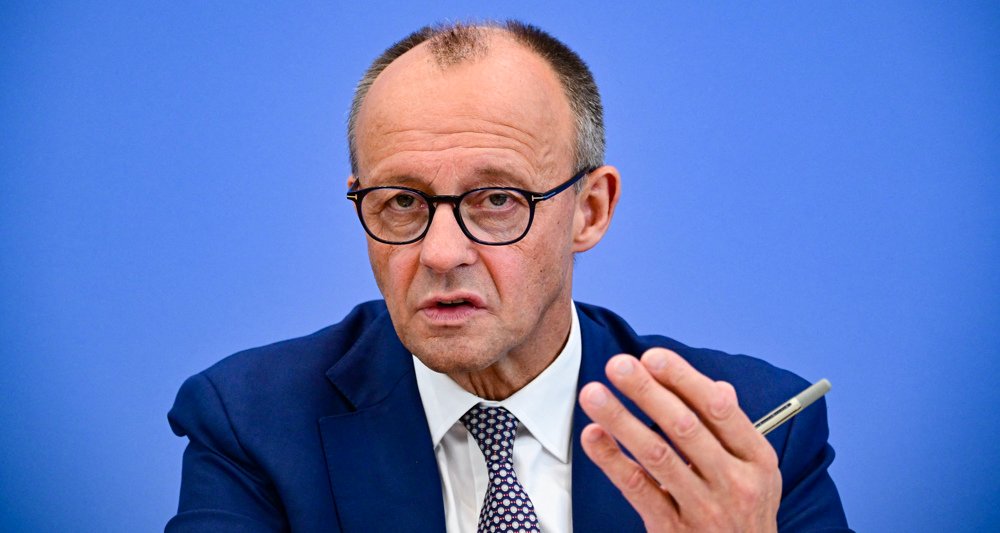












































In a bold and wide-ranging summer press conference on Friday, German Chancellor Friedrich Merz laid out his administration’s top priorities for the coming years, focusing on revitalizing the nation’s economy, strengthening European defense, and addressing migration challenges. Speaking candidly to journalists in Berlin, Merz also delivered a scathing critique of the European Union’s bureaucracy, calling for urgent reforms.
Merz, who assumed office amid economic stagnation and geopolitical uncertainty, declared that his primary goal is to pull Germany out of its current recession. “Restoring growth and competitiveness is our number one objective,” he said, acknowledging the pressing need to reestablish Germany as the economic engine of Europe.
He underscored the dual challenge Germany now faces: regaining productivity lost during years of stagnation and positioning the country to thrive in a rapidly changing global economy. Economists have warned that Germany’s industrial backbone, particularly in sectors like automotive and energy, is under increasing pressure due to high energy prices, regulatory burdens, and supply chain disruptions.
“Germany needs to move faster, act smarter, and become more competitive,” Merz said. “This means not just investing in innovation, but also cutting through the red tape that slows down progress.”
Merz did not shy away from criticizing the European Union, describing it as “too rule-heavy, too bureaucratic, too slow to respond to the needs of its citizens.” He called for sweeping institutional reforms to streamline EU operations and better equip the bloc to tackle modern challenges, from energy transition to security cooperation.
Turning to security and foreign policy, Merz emphasized the importance of enhancing European defense, especially in light of Russia’s continued aggression in Eastern Europe and instability in the Middle East. He reaffirmed Germany’s commitment to NATO and signaled closer defense ties with key European allies, including French President Emmanuel Macron, Polish Prime Minister Donald Tusk, and British Prime Minister Keir Starmer.
He also noted that discussions with the Biden administration — and now President Donald Trump — have intensified regarding Washington’s increasingly protectionist trade policies and the ongoing conflict in Gaza. “We are in continuous dialogue with our American partners,” Merz said. “We want to contribute positively, especially on the humanitarian situation in Gaza.”
Germany is exploring options to facilitate the delivery of humanitarian aid to the besieged Gaza Strip, Merz confirmed, amid a worsening crisis that has displaced hundreds of thousands and drawn international concern.
While speaking on Israel, Merz pushed back against comparisons between Israel and Russia, saying the two countries are “fundamentally different,” and reaffirmed Israel’s status as a democracy despite the ongoing war in Gaza. His comments came amid growing European debates over Israel’s conduct and humanitarian responsibilities in the region.
On domestic issues, migration remained a key topic. Merz, a longtime critic of former Chancellor Angela Merkel’s 2015 open-door refugee policy, struck a diplomatic tone. He refrained from attacking Merkel directly but stated that his administration is “on course to correct” what he described as the long-term consequences of “Wir schaffen das” (“We will manage it”).
To that end, Merz highlighted recent deportation efforts, including the removal of 81 Afghan nationals back to Afghanistan on Friday. While Germany does not formally recognize the Taliban’s rule, Merz acknowledged that diplomatic cooperation with countries like Qatar has been essential in carrying out deportations safely and lawfully.
“Germany remains committed to upholding international law and human rights, but we also must enforce our immigration policies effectively,” he stated.
Observers noted that Merz’s statements signal a shift in tone from the previous center-left government. His remarks attempted to strike a balance between Germany’s traditionally open values and growing pressure from conservatives and centrists demanding tighter immigration control.
As Germany grapples with demographic decline, industrial slowdown, and geopolitical instability, Merz’s leadership is likely to be defined by how effectively he navigates these overlapping crises. His vision involves modernizing Germany’s economy, ensuring national security, and pushing the EU to become a more agile and responsive institution.
“We are not just managing challenges — we are setting a new course for Germany,” Merz concluded. “One that is pragmatic, forward-looking, and grounded in European solidarity.”
Whether Merz can deliver on this ambitious agenda remains to be seen, but his assertive tone and focus on economic revitalization mark a clear shift in Germany’s post-Merkel political landscape.