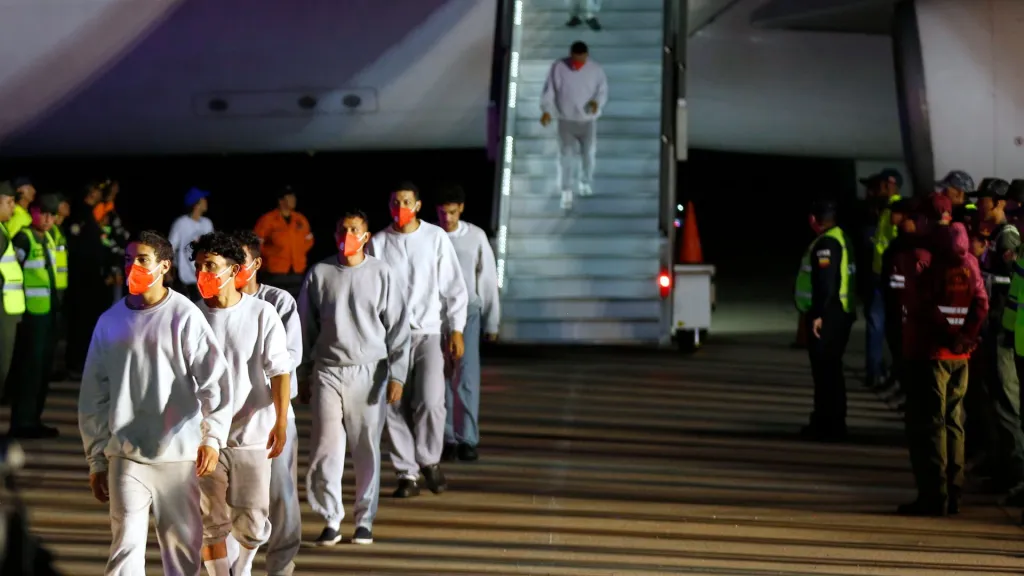























































Migration advocacy groups and human rights organizations are raising alarms over El Salvador’s lack of comprehensive reintegration strategies for deported migrants, especially as the number of returnees from the United States surges. With deportation flights increasing significantly under the current U.S. administration led by President Donald Trump, critics say the Salvadoran government is failing to support those forced back into a country they no longer consider home.
Between January and June 2025, El Salvador received 85 deportation flights from the U.S.—a 32% increase compared to the same period in 2024, when 64 such flights arrived. According to data compiled by Witness at the Border, 81 of these flights were authorized during President Trump’s current term. While the government has not released official figures on the number of people deported, the scale of the increase has raised concerns among migration experts and advocacy groups.
César Ríos, director of the El Salvador Migrant Agenda Association, warned that the country lacks the public policy infrastructure necessary to accommodate and support returnees. “This isn’t just an economic problem,” Ríos said. “It’s a deeply emotional and cultural issue. Many returnees have lived in the U.S. for over a decade, and their return triggers a form of migratory grief — an emotional trauma rooted in the loss of everything they once called home.”
Migratory grief, as described by Ríos, encompasses the psychological toll of being uprooted from familial, cultural, and social ties in the U.S. For many, reintegration into Salvadoran society is overwhelming. They face cultural disorientation, economic hardship, and a sense of alienation in what is technically their country of origin but emotionally feels foreign.
One of the core issues, Ríos said, is the mismatch between the skills that returnees bring and the demands of the Salvadoran labor market. “These individuals are often equipped with experience in sectors like construction, services, or technology,” he explained. “But they return to a country that offers little opportunity to use those skills in a meaningful way.”
To make matters worse, some deportees—especially those flagged under joint U.S.-El Salvador security protocols—are taken directly from American detention centers to El Salvador’s Terrorism Confinement Center (CECOT), without being allowed to contact family or legal counsel. These transfers, frequently originating from detention facilities in Arizona and Louisiana, are raising concerns over human rights and due process violations.
Óscar Chacón, strategic advisor at Alianza Américas, described the concept of “reintegration” in El Salvador as largely fictional. “You can’t reintegrate people into a country that lacks robust economic, political, and social systems,” he argued. “The Salvadoran state was never prepared for mass returns. It relied heavily on the assumption that migration—and the remittances it brings—would continue indefinitely.”
Chacón noted that successive governments have prioritized short-term economic benefits over long-term planning. “Remittances have become a lifeline for both families and state revenues,” he said. “But no contingency funds or reintegration infrastructure were ever developed to support those who come back, willingly or not.”
The country’s failure to address the root causes of migration—poverty, lack of jobs, poor education, and insufficient healthcare—has only exacerbated the crisis. Chacón described the current situation as “systemic neglect,” saying, “We’ve never had the policies needed to keep people from leaving, let alone help them come back with dignity.”
In response to growing pressure, El Salvador’s Ministry of Foreign Affairs recently launched the Project for the Protection of People in Mobility, backed by $3.4 million from the Multi-Donor Migration Fund and administered in collaboration with United Nations agencies. The initiative aims to provide expanded support and services for returning migrants in San Salvador, Santa Ana, and San Miguel—areas identified as having high mobility rates.
Deputy Minister of Diaspora and Human Mobility, Cindy Portal, said the project will focus on employment training, entrepreneurship, institutional capacity-building, and public awareness campaigns. She described the program as a “multifactor approach” involving local governments, NGOs, private sector partners, and migrant associations.
However, critics remain skeptical. “You can’t heal the trauma of forced displacement with a small business loan or a short-term training session,” Ríos emphasized. “Reintegration programs must be rooted in mental health care, social reintegration, and above all, understanding of migratory grief.”
Both Ríos and Chacón stressed the critical role local governments could play in reintegration if given the right resources and support. “Municipal leaders are closest to the communities and can provide a human connection to the returning migrants,” Ríos noted. “But without training and funding, their ability to help remains limited.”
The experts also argue that returning migrants should not be seen as a burden, but as an asset. “These individuals bring valuable skills and global experience,” Chacón said. “If the Salvadoran state can harness that potential through proper reintegration strategies, it could lead to economic revitalization—especially in underserved regions.”
As deportations continue to rise and the humanitarian needs of returnees become more urgent, advocates are calling on the Salvadoran government to act swiftly. Without systemic change, they warn, the cycle of migration, displacement, and despair will only deepen.