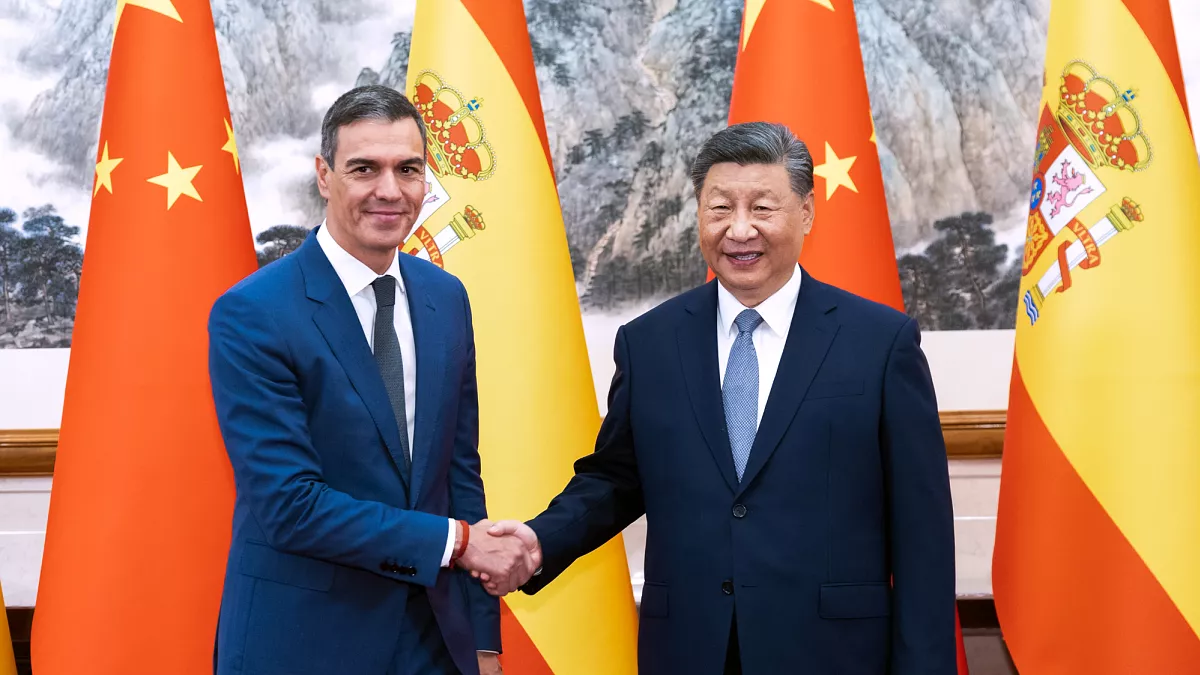




















































Chinese President Xi Jinping has called for closer cooperation between China and the European Union in resisting unilateralism and protectionist trade policies, particularly in light of rising global tensions spurred by new U.S. tariffs. Speaking during a meeting in Beijing with Spanish Prime Minister Pedro Sánchez, Xi emphasized that trade wars bring no winners and that attempts to isolate a nation from the global economy are bound to backfire.
Xi stated that over the past seven decades, China has relied on its own efforts for progress and has never depended on outside support or yielded to foreign pressure. Despite current international challenges, China remains committed to its own path and development.
Highlighting the deep economic interdependence between China and the EU—which together account for more than a third of the world’s total GDP—Xi said both parties should uphold the principles of globalization and open trade, pushing back against unilateral policies that threaten the rules-based international system.
Sánchez expressed Spain’s commitment to multilateralism and reiterated the EU’s stance against escalating trade tensions. He underscored the importance of continued cooperation with China to address pressing global challenges like climate change and economic inequality. During the visit, China and Spain jointly released a roadmap for strengthening their strategic partnership over the next four years.
The meeting occurred as Washington moved to impose sweeping new tariffs on Chinese imports, prompting concerns across the globe. The U.S. recently raised tariffs on many Chinese goods to a cumulative 125%, actions that Beijing sees as a breach of trade norms.
Jin Ling, a senior analyst at the China Institute of International Studies, noted that Sánchez’s trip to China during this tense period holds strategic value. He emphasized the need for open economies like China and those in Europe to work together to preserve global trade stability and resist growing protectionism.
China Responds Firmly to U.S. Tariff Measures
In response to the U.S. tariff hikes, China announced it would raise tariffs on select U.S. products to match the 125% level. The Chinese government criticized the American approach as a violation of economic logic and global trade rules, accusing Washington of resorting to coercive tactics under the guise of reciprocity.
China’s Ministry of Commerce also confirmed it had filed a formal complaint with the World Trade Organization over the latest U.S. tariff measures. Officials stated the move is necessary to protect China’s legitimate interests and the broader multilateral trading system.
Bai Ming, an expert from the Chinese Academy of International Trade and Economic Cooperation, described the U.S. actions as economically extreme and doomed to fail. He said China’s strength lies in its measured and rules-based approach, backed by a robust economy and strong trade fundamentals.
Official customs data show that in 2024, China’s total trade in goods reached a new high of nearly 44 trillion yuan (approximately $6.1 trillion), further solidifying its position as the world’s top trading nation.
He Weiwen, a senior researcher at the Center for China and Globalization, said that China’s calm and calculated response to U.S. tariffs contrasts sharply with Washington’s confrontational posture. He criticized U.S. protectionism for undermining the very trade system it once helped establish.
Standing Up for Global Fairness
Foreign Minister Wang Yi also weighed in on the issue during a meeting in Beijing with International Atomic Energy Agency Director General Rafael Mariano Grossi. Wang accused the U.S. of placing its interests above global norms and attempting to reshape the international order through economic pressure.
Wang emphasized that China’s resistance to such tactics is not only about defending its sovereignty but also about safeguarding the collective interests of the global community.
Echoing this, Foreign Ministry spokesperson Lin Jian said China’s actions are intended to uphold global fairness and justice, especially in the face of what he described as U.S. efforts to suppress China under the pretext of correcting trade imbalances.
Experts warned that if left unchecked, U.S. trade practices could roll back decades of global trade progress. They also noted that China’s firm yet measured stance might serve as a model for other countries navigating similar challenges.
While some nations may feel compelled to acquiesce to U.S. pressure, China’s resilience could encourage others to defend their own economic sovereignty. Online, sentiments in support of China’s approach have gained traction, with global netizens voicing hope that China continues to champion fair trade, innovation, and international cooperation.