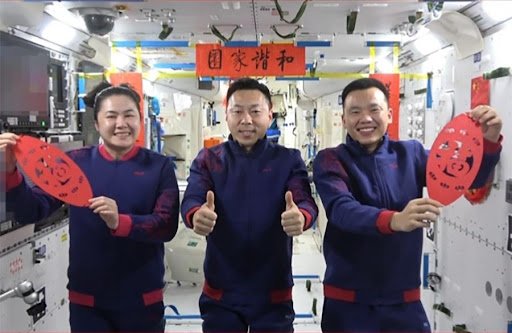

















































As the Shenzhou-19 mission nears its conclusion, astronauts Cai Xuzhe, Song Lingdong, and Wang Haoze continue making steady progress on a range of space science experiments aboard China’s Tiangong space station.
According to a recent report by CCTV, the crew has been engaged in experimental studies involving brainwave monitoring devices. The data collected will help Earth-based scientists explore how microgravity impacts cognitive functions, particularly in visual-motor coordination. Researchers also aim to better understand how spatial perception works in zero-gravity and evaluate the potential of brainwave-based musical interventions in supporting mental performance during long-duration missions.
Over the past six months, the astronauts have also contributed to assessments of the station’s livability. Through surveys and recorded footage, they provided real-time feedback on how equipment is arranged and how humans interact with machines in orbit. This feedback is expected to inform future design improvements in both ergonomics and onboard comfort.
The trio also participated in in-orbit drug research, collecting data that could shape future guidelines for medication use during spaceflight. In addition to biology-focused work, the crew supported aerospace technology trials. Among them was the ongoing installation and evaluation of an advanced space refrigeration system inside the payload module.
The refrigeration project aims to support future deep-space missions. It involves testing gas-lubricated bearings designed to operate at ultra-high speeds, helping to enhance China’s long-term space thermal management technology.
On the physics side, the astronauts conducted scheduled microgravity experiments, including sample swaps in both the fluid dynamics and high-temperature materials science racks. They also carried out procedures related to vacuum pumping and exhaust handling.
Environmental monitoring also formed part of the crew’s weekly routine, with checks on airflow, temperature, and air quality. Routine maintenance of onboard systems was also conducted.
Health and safety remained a priority. The astronauts completed a battery of medical checks, including heart monitoring, lung function tests during exercise, and cardiovascular assessments. They also continued using standard countermeasures to mitigate the effects of prolonged weightlessness.
Looking ahead, the Tiangong space station is set to receive two new crews later this year—Shenzhou-20 and Shenzhou-21—as well as a resupply mission via the Tianzhou-9 cargo ship. According to Xinhua News Agency, preparations and training for the upcoming missions are already underway.