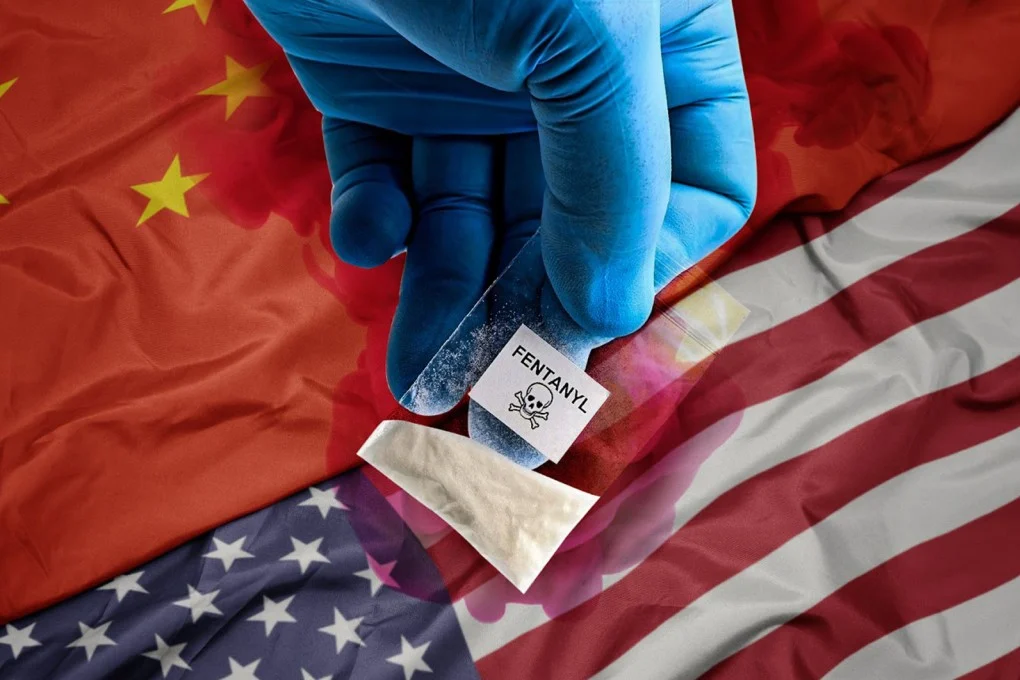



























































The Chinese government has firmly pushed back against recent remarks made by U.S. President Donald Trump, who claimed that China will soon begin sentencing individuals to death for manufacturing and distributing fentanyl—a highly potent synthetic opioid that has played a central role in the United States’ ongoing drug crisis.
During a recent public appearance, Trump expressed optimism about future cooperation with Beijing on combating the flow of illicit drugs, suggesting that China is preparing to impose capital punishment on those involved in fentanyl production. However, Chinese officials were quick to dismiss the claim and refocus the conversation on what they describe as America’s own failures in addressing its drug epidemic.
Chinese Foreign Ministry spokesperson Lin Jian responded directly to Trump’s comments during a regular press briefing, stating that the U.S. opioid crisis is “America’s problem, not China’s,” and reiterated that the root causes of the issue lie within the United States itself.
“China has repeatedly made its position clear,” Lin said. “The United States bears the primary responsibility for its own fentanyl abuse problem. Shifting blame to China not only avoids accountability but also undermines the foundation for meaningful cooperation.”
Lin also criticized the U.S. government for undermining bilateral anti-narcotics efforts by implementing unilateral trade restrictions. In particular, he pointed to the imposition of tariffs on Chinese-produced chemicals, including those that are unrelated to narcotics but still essential for industrial use. According to Lin, such actions have severely impacted China-U.S. dialogue on counternarcotics and have caused significant damage to China’s national interests.
“If the United States genuinely wants to engage in meaningful cooperation, it must acknowledge objective realities and pursue dialogue with China on the basis of equality, mutual respect, and shared benefit,” he added.
The back-and-forth highlights ongoing diplomatic friction between the two nations regarding fentanyl, which has become a focal point in broader U.S.–China relations. While U.S. officials have long accused Chinese firms of supplying the chemical precursors used to manufacture fentanyl and other synthetic opioids, China maintains that it has taken comprehensive steps to regulate such substances and that enforcement alone cannot solve what is fundamentally a domestic public health crisis in the U.S.
In May 2019, under pressure from Washington, China officially added fentanyl-related substances to its list of controlled narcotics. Chinese authorities have since taken action against domestic labs and online sellers, including increasing monitoring of suspicious shipments and improving inter-agency coordination. Nevertheless, China insists that its efforts should be met with reciprocal good faith rather than what it views as politically motivated pressure tactics.
The issue of fentanyl has become increasingly politicised in the U.S., particularly during election cycles. President Trump has often blamed foreign governments for the drug crisis, accusing China and Mexico of enabling the flow of deadly opioids into American communities. Fentanyl overdoses are now the leading cause of death for Americans aged 18 to 45, prompting calls for aggressive enforcement, border security, and international cooperation.
However, experts argue that simply focusing on supply chains misses the broader picture. The U.S. opioid epidemic has deep roots in over-prescription, inadequate treatment options, and socioeconomic issues. Efforts to curb the crisis, they argue, must go beyond finger-pointing and include coordinated public health initiatives, rehabilitation programs, and responsible international engagement.
Diplomatic analysts say that unless the U.S. and China can establish a framework based on transparency and trust, their efforts to address transnational drug trafficking will remain limited. Meanwhile, China continues to position itself as a cooperative partner—but one that insists on being treated as an equal.
“The path forward lies in constructive dialogue, not inflammatory rhetoric,” Lin concluded. “We are willing to work with the U.S., but only under conditions of mutual respect and fairness.”
As the fentanyl crisis continues to claim lives across the United States and further strains U.S.-China relations, the international community is watching closely to see whether the two powers can put aside political posturing and find common ground on one of the most pressing public health challenges of the 21st century.