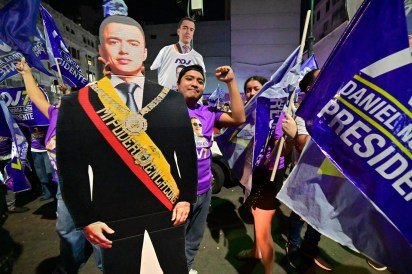















































Ecuador has re-elected President Daniel Noboa, granting him a full four-year term after he first took office in a 2023 snap election. The 37-year-old businessman-turned-politician has stirred debate with his uncompromising approach to tackling gang violence and organized crime, a stance that helped him secure 55.8% of the vote according to preliminary results from Ecuador’s National Electoral Council.
His opponent, left-leaning lawyer Luisa Gonzalez, captured 44% of the vote but has refused to accept the outcome, citing what she described as “grotesque” electoral fraud. Gonzalez claimed that pre-election polls had shown her in the lead and has called for a full recount.
More than 13 million Ecuadorians were eligible to vote in Sunday’s election, which is mandatory under the country’s laws. Despite the dispute, council president Diana Atamaint declared the results showed an “irreversible trend” in Noboa’s favor. International observers from the EU and the Organization of American States monitored the election, though their reports have not yet been published.
Noboa, the heir to a banana-exporting empire, entered politics with little prior experience but gained popularity for his tough rhetoric and strong-handed tactics to combat drug-related violence. During his brief initial term, he declared a state of “internal armed conflict,” granting the military broad powers to operate domestically. Thousands of soldiers were deployed, prisons were placed under military control, and alleged gang members were charged with terrorism.
These actions have been both praised and criticized. While many voters saw the crackdown as a necessary response to spiraling violence—particularly from the influence of Mexican cartels like Sinaloa and Jalisco New Generation—human rights groups including Human Rights Watch have raised alarms over reports of arbitrary arrests and extrajudicial killings carried out by security forces.
Nonetheless, homicide rates in Ecuador have declined under Noboa’s leadership, falling from 46.18 per 100,000 people in 2023 to 38.76 per 100,000 in 2024. Still, this remains significantly higher than the 6.85 per 100,000 recorded in 2019, highlighting the ongoing challenges the country faces.
The recent election marks another setback for the political movement led by former president Rafael Correa. Gonzalez’s loss is the third consecutive failure for his party to reclaim the presidency.
Throughout their campaigns, both Noboa and Gonzalez pledged stronger support for law enforcement and closer international cooperation to tackle criminal networks. After advancing from February’s first round of voting, Noboa eventually widened his lead over Gonzalez by more than 17,000 votes.
While Noboa prepares to embark on a full term, the legitimacy of his victory is likely to remain under scrutiny as opposition figures push for transparency and further investigation into the electoral process.