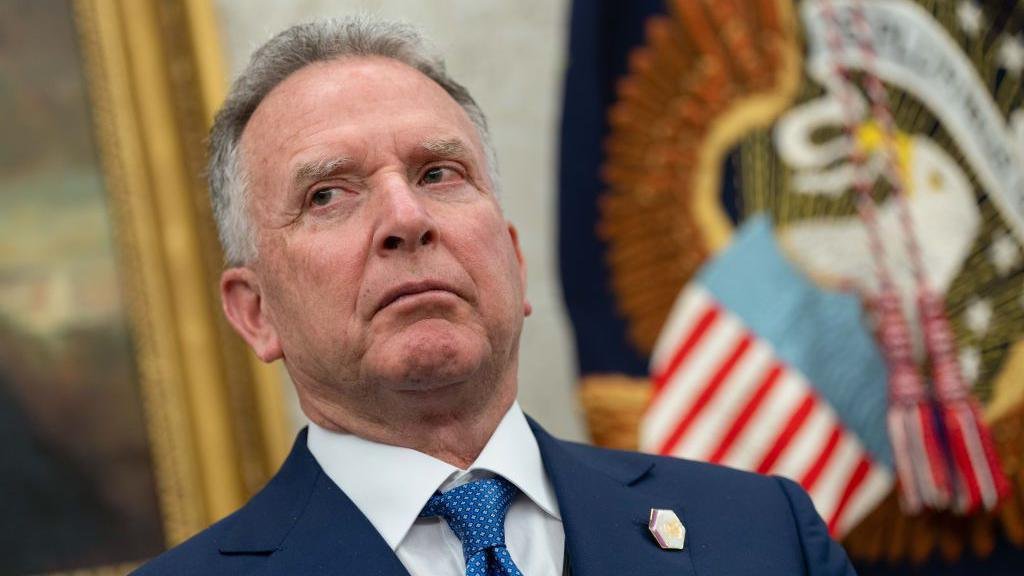





















































U.S. special envoy Steve Witkoff concluded a lengthy meeting with Russian President Vladimir Putin in St. Petersburg on Friday, marking the latest step in renewed diplomatic efforts to resolve the ongoing conflict in Ukraine. The talks come amid growing pressure from President Donald Trump to accelerate progress toward ending what he has called Russia’s “senseless war.”
The meeting, held at the presidential library, reportedly lasted four and a half hours. While the Kremlin confirmed that the discussion took place, it offered few specifics, only noting that the talks covered “various aspects of the Ukrainian settlement.” Kremlin spokesman Dmitry Peskov tempered expectations beforehand, stating there would likely be no major diplomatic breakthroughs from this third round of dialogue between Putin and Witkoff since February.
Asked whether the possibility of a direct meeting between Trump and Putin was discussed, Peskov responded with a noncommittal “maybe.”
Witkoff, a longtime associate of Trump from his real estate ventures, has taken a notably conciliatory tone in his engagements with the Russian leader. Following their previous meetings, he described Putin as a “great leader” and “not a bad guy,” signaling a marked shift in tone from past U.S. administrations’ stance on Moscow.
In addition to the meeting with Putin, Witkoff also sat down with Kirill Dmitriev, head of the Russian Direct Investment Fund and a close economic adviser to the Kremlin. Their meeting took place at the Grand Europe Hotel, and video footage captured the two men departing in separate vehicles. Dmitriev had recently visited Washington, and after those discussions, he expressed “cautious optimism” about future U.S.-Russia relations.
Witkoff’s visit to Russia follows the recent release of dual national Ksenia Karelina in a prisoner exchange between Washington and Moscow. Karelina was freed in Abu Dhabi in return for Arthur Petrov, a dual German-Russian national accused by U.S. authorities of illicit technology exports to Russia. The exchange marks another point of contact in a broader attempt to stabilize relations and facilitate more cooperation on humanitarian matters.
Earlier this year, Witkoff was also involved in negotiating the release of American teacher Marc Fogel, who had been imprisoned in Russia on drug charges. Fogel’s return, traded for Russian national Alexander Vinnik — a figure associated with cryptocurrency activities — was widely viewed as a diplomatic win for the Trump administration.
The envoy’s latest visit takes place against the backdrop of rising tensions on the battlefield. Both Kyiv and Moscow have accused each other of breaking a temporary halt in attacks on energy infrastructure, dimming hopes for a lasting or even partial ceasefire.
As frustrations mount, Trump has reportedly considered escalating pressure on Moscow. According to insiders, if a comprehensive ceasefire is not secured by the end of April, Washington may move to impose new sanctions on Russia—either through executive action or congressional legislation.
Despite these tensions, Trump struck a cautiously hopeful note earlier in the week, stating that negotiations were “getting relatively close” to achieving a ceasefire.
Witkoff’s efforts are now seen as part of a broader push to shift the conflict’s trajectory through backchannel diplomacy and economic leverage. His meetings in St. Petersburg underscore the Trump administration’s effort to navigate a complex geopolitical landscape in search of a resolution to one of Europe’s most devastating conflicts in decades.