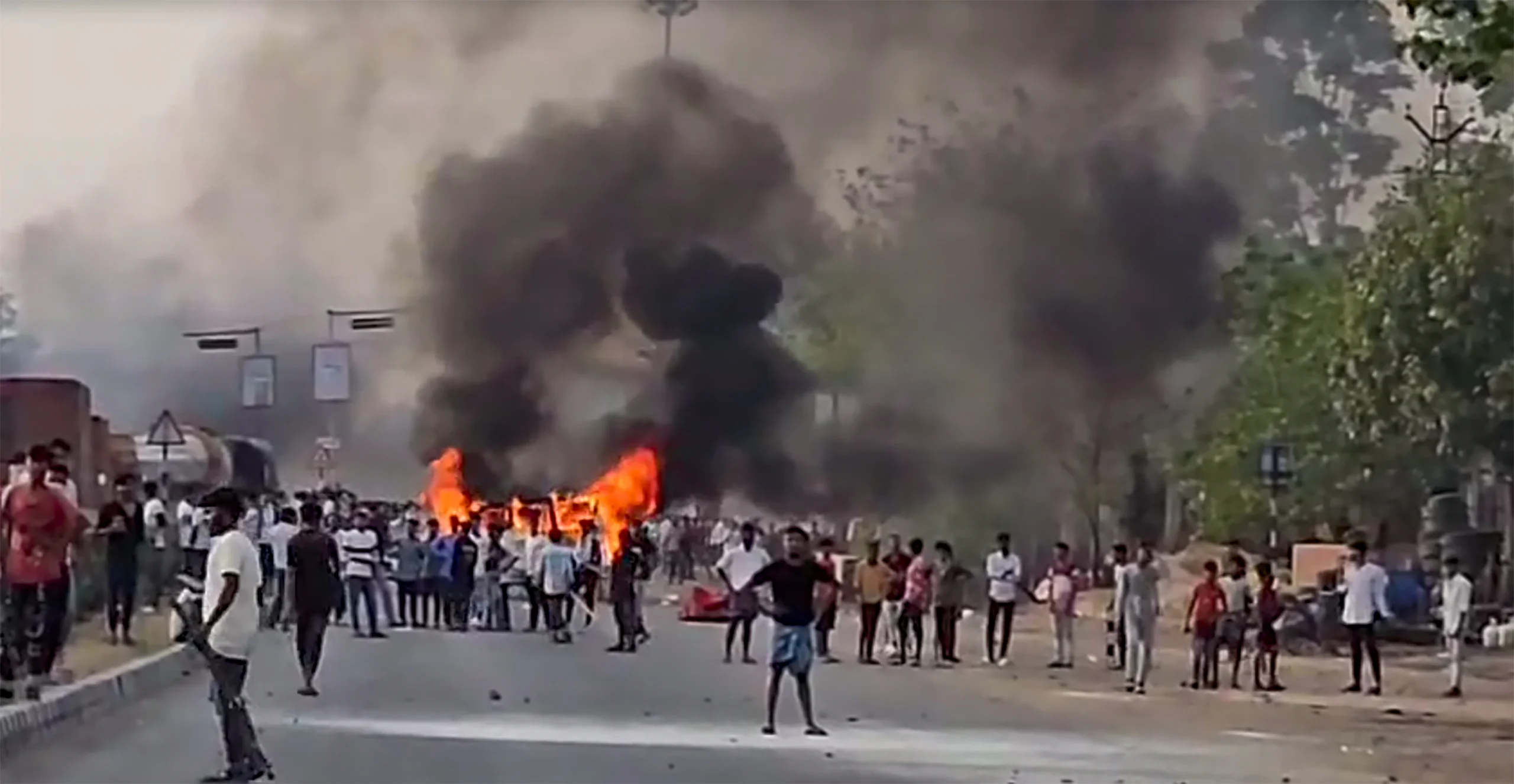



















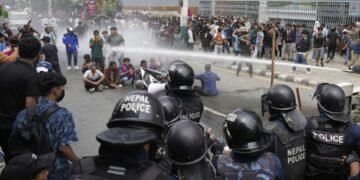




































In the aftermath of widespread unrest in West Bengal’s Murshidabad district, more than 150 individuals have been arrested in connection with violent protests that erupted following the recent passage of the amended Waqf Act. Tensions have escalated significantly in the Muslim-majority district, prompting the deployment of five companies of the Border Security Force (BSF) to assist state police in restoring law and order. Though no new incidents of violence have been reported since the deployment, the region remains tense and under heavy surveillance.
The violence, which broke out amid simmering discontent over the amended legislation, has led to at least three fatalities. Several vehicles were set ablaze, and security personnel were targeted with stones during the chaos. In response, raids were conducted across several locations in West Bengal, including Murshidabad, Malda, and South 24 Parganas. The situation became so critical that the Calcutta High Court ordered the immediate deployment of Central forces, underscoring the severity of the unrest. IG South Bengal Frontier Karni Singh Shekhawat noted that BSF personnel would coordinate closely with state authorities, emphasizing that their role is to assist, not act independently. He added that additional forces would be dispatched if required, expressing hope that peace would soon return to the region.
The political fallout from the violence has been swift and fierce. The Bharatiya Janata Party (BJP) has strongly criticized the state government, accusing it of failing to maintain public order and alleging that its policy of appeasement has emboldened radical elements. Suvendu Adhikari, Leader of the Opposition in the West Bengal Assembly, claimed that more than 400 Hindus had been driven from their homes in Dhulian, Murshidabad, by fear and intimidation. According to Adhikari, these displaced individuals had to cross the Bhagirathi River and seek shelter in nearby Malda district, taking refuge in a local school.
Adhikari also shared disturbing visuals and testimonies from the affected areas. In one video, a man alleged that his house had been torched and that the police, rather than intervening, had retreated from the scene. In a passionate appeal on social media, Adhikari urged security forces to ensure the safe return of displaced Hindus and to protect them from what he described as “jihadist terror.” He warned that the state’s social fabric was tearing apart and criticized the government for allowing a complete breakdown in law and order.
The ruling Trinamool Congress (TMC), led by Chief Minister Mamata Banerjee, responded by convening a meeting aimed at addressing the concerns of the aggrieved Muslim community. TMC MP Saugata Roy stated that the chief minister is taking the matter seriously and wants to ensure peace returns to the streets. He characterized the unrest as a spontaneous reaction to a bill that has upset many people, particularly within the Muslim community, and noted that efforts are being made to pacify tensions.
On the other side of the political divide, the BJP has continued to ramp up pressure on the state government. Jyotirmay Singh Mahato, a BJP Member of Parliament from West Bengal, wrote to Union Home Minister Amit Shah, requesting that select border districts of the state be declared “disturbed areas” under the Armed Forces Special Powers Act (AFSPA). This, he argued, would allow security forces broader powers to tackle what he described as a deteriorating law and order situation.
Further criticism came from BJP’s national IT cell head Amit Malviya, who accused the West Bengal Police of being demoralized and reluctant to act. According to Malviya, police officers refused to enter riot-affected areas until the BSF arrived. He claimed that even the state’s Director General of Police had to be physically present to motivate the force into action. Malviya went on to say that Mamata Banerjee frequently uses the police as a political shield, adding that other TMC leaders appear to have abdicated their responsibilities entirely.
The Waqf (Amendment) Act itself has become the focal point of fierce opposition. All India Muslim Personal Law Board and several other Muslim organizations have announced a large-scale protest in Hyderabad on April 19. The event will be attended by influential religious leaders and activists, who argue that the amended legislation undermines the rights of Waqf boards and is designed to facilitate land grabs under the guise of reform.
Jamiat Ulema-e-Hind chief Mahmood Madani has also spoken out forcefully against the Act, calling it a politically motivated tool intended to dispossess Muslims of their land. He accused the government of manufacturing a narrative to justify the changes, suggesting that the legislation serves the interests of real estate developers and land mafias rather than those of the community. Madani warned that the Act is detrimental not only to Muslims but to the overall health of the nation’s democratic institutions.
Meanwhile, the Union Home Secretary has assured full central support to the West Bengal government. In a high-level video conference with the state’s chief secretary and police chief, he stressed the importance of monitoring other sensitive districts and pledged additional manpower if needed. Security forces have been conducting regular patrols, checking vehicles, and imposing prohibitory orders in violence-prone areas. Internet services have also been temporarily suspended to curb the spread of misinformation and prevent further escalation.
The political storm shows no sign of abating. BJP’s West Bengal president Sukanta Majumdar accused Mamata Banerjee of handing the state over to “jihadis” for the sake of vote-bank politics. He described the Calcutta High Court’s verdict as a “slap on the face” of the state government and questioned Mamata’s capacity to govern.
The Murshidabad violence has triggered a complex and volatile mix of communal tensions, political rivalry, and public outrage. As the situation continues to unfold, both the state and central governments face increasing pressure to address the root causes of the unrest and restore a sense of stability to the region.