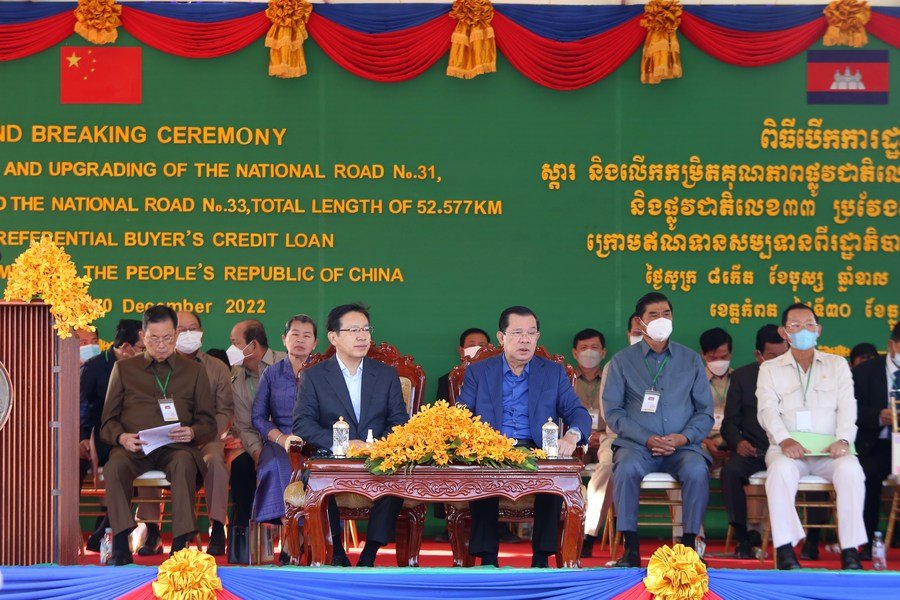



























































Cambodia has officially opened a major infrastructure project backed by China—National Road 71C—aimed at boosting the country’s economic activity and regional connectivity. Stretching nearly 115 kilometers, the road links Tbong Khmum province in the east with Kampong Cham province in the southeast, and is expected to significantly enhance transportation and trade.
Prime Minister Hun Manet, speaking at the inauguration ceremony on Saturday, hailed the road as a critical addition to the nation’s infrastructure, saying it would ease the movement of people and goods while stimulating economic development and tourism along its route.
“This road will improve the efficiency of agricultural and agro-industrial exports, especially rubber,” said Hun Manet. “It will also encourage more investors and tourists to visit the areas it connects.”
He also acknowledged China’s central role in Cambodia’s development, referring to the country as an “indispensable friend.” He noted that China has remained Cambodia’s leading infrastructure partner, offering both loans and grants for key projects like roads and bridges.
Hun Manet highlighted the close cooperation between Cambodia’s Pentagonal Strategy and China’s Belt and Road Initiative, calling their alignment a source of “win-win” outcomes for both nations.
Chinese Ambassador to Cambodia Wang Wenbin echoed those sentiments, pointing out that China has supported the construction of over 4,000 kilometers of national roads and more than 10 major bridges across the country.
“These infrastructure projects, including crossings over the Mekong and Tonle Sap Rivers, have not only improved daily transportation for Cambodian citizens but also brought new vitality to the country’s economic development,” Wang said.
The road was constructed by the Shanghai Construction Group over a period of 42 months, according to Cambodia’s Minister of Public Works and Transport Peng Ponea. He explained that the new route will play a vital role in connecting nearby provinces, facilitating trade, and supporting the movement of agricultural goods, thereby reducing logistical costs and saving time.
Local residents are already seeing the benefits. Taing Sim, a farmer from Kampong Cham province, shared that travel in the area used to be difficult, particularly during the rainy season, when roads became muddy and impassable.
“Now the road is smooth, making it easier and faster to transport crops like tapioca, cashew nuts, and rubber,” she said, adding her gratitude for China’s contribution to Cambodia’s infrastructure development.
She recalled a Cambodian saying: “Where there is a road, there is hope,” noting that China’s efforts have quite literally paved the way for a more hopeful future for many communities.
Another local, Heng Sivleng, reflected on the improved travel experience. Previously, a motorcycle journey between the two provinces could take up to three hours due to poor road conditions. With the new road, she said, travel is faster, more convenient, and more affordable.
The completion of National Road 71C marks another milestone in the growing partnership between Cambodia and China and underscores the importance of infrastructure in driving sustainable economic progress.