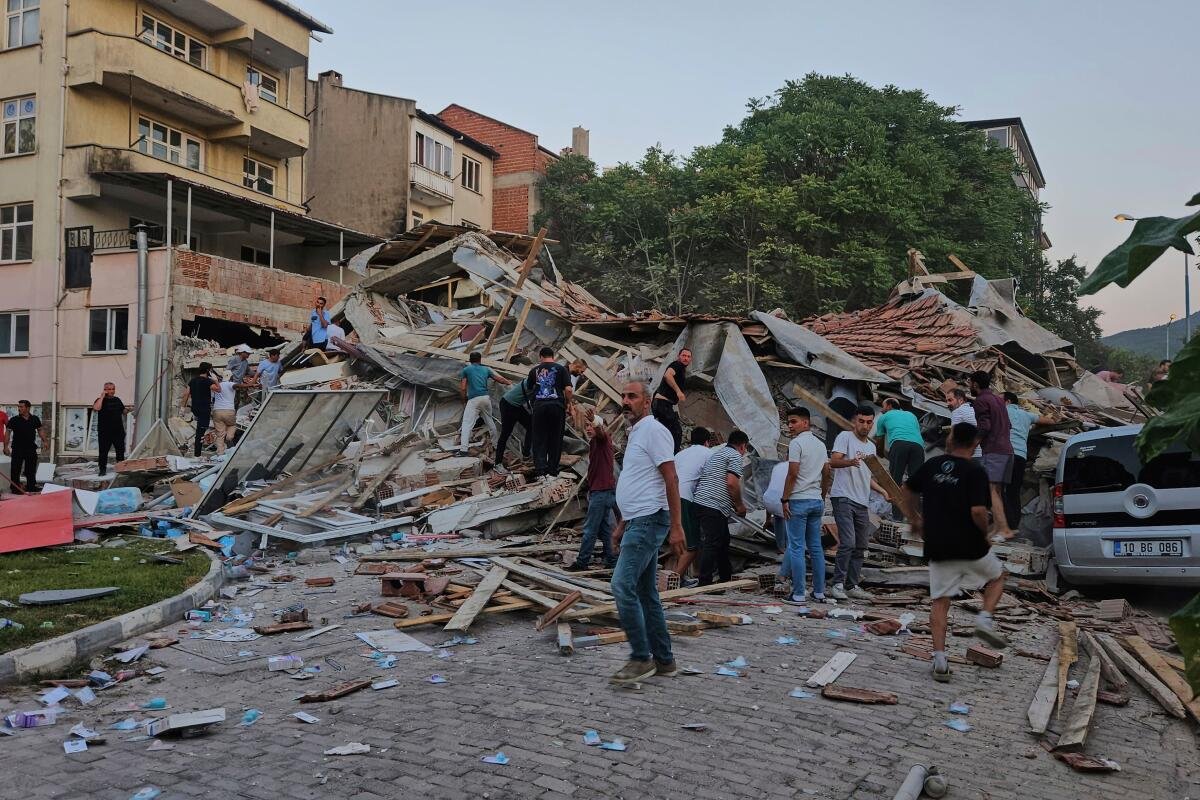


























































A devastating earthquake with a magnitude of 6.1 on the Richter scale struck the western region of Turkey, resulting in the tragic death of an elderly individual, as reported by the country’s Interior Minister. The unfortunate victim, an 81-year-old, lost their life post being retrieved from the debris by the emergency response teams.
Earthquakes are quite common in Turkey due to its geographical location sandwiched between several major fault lines. The nation is crisscrossed by these geological fractures that have led to a history of severe seismic activity. The latest earthquake is another unfortunate addition to this long chronicle of geological turmoil.
Rescue operations were rapidly launched in the aftermath of the earthquake, with emergency teams working tirelessly to search for survivors amongst the rubble. The 81-year old casualty was one such individual who was pulled out from the ruins. Despite their efforts to save the victim, the emergency services sadly reported their death. The victim’s age likely played a significant role in their inability to survive the severe trauma caused by the quake.
The magnitude of an earthquake is a measure of the energy released at the source. It is determined from measurements on seismographs. The magnitude 6.1 earthquake that struck western Turkey is considered to be a ‘strong’ earthquake on the Richter scale. This level of seismic activity has the potential to cause severe damage in populated areas, particularly to buildings and other structures not built to withstand such forces.
Turkey’s position along the Eurasian tectonic plate boundary has made it a hotbed for seismic activity. This boundary is a significant fault line where the Eurasian plate and the African plate meet, causing frequent seismic activity. The western part of Turkey, where this earthquake occurred, is particularly prone to earthquakes due to the North Anatolian Fault (NAF). The NAF is an active right-lateral strike-slip fault in northern Turkey that extends westward from a junction with the East Anatolian Fault at the Karliova Triple Junction into the Aegean Sea.
The country has seen its fair share of deadly earthquakes in the past. The most devastating in recent memory was the 1999 Izmit earthquake that resulted in around 17,000 deaths and extensive damage to property and infrastructure. This event highlighted the importance of adequate building regulations and the need for effective emergency response mechanisms in a region prone to such calamities.
Despite the tragic loss of life in the recent earthquake, the swift response of emergency teams is commendable. Their rapid deployment and immediate search and rescue operations likely prevented further casualties and demonstrated the progress Turkey has made in disaster response since the devastating 1999 earthquake.
However, this incident serves as a stark reminder of the constant threat of seismic activity faced by Turkey. It underscores the importance of continued investment in earthquake preparedness, including public education, building safety regulations, and response mechanisms.