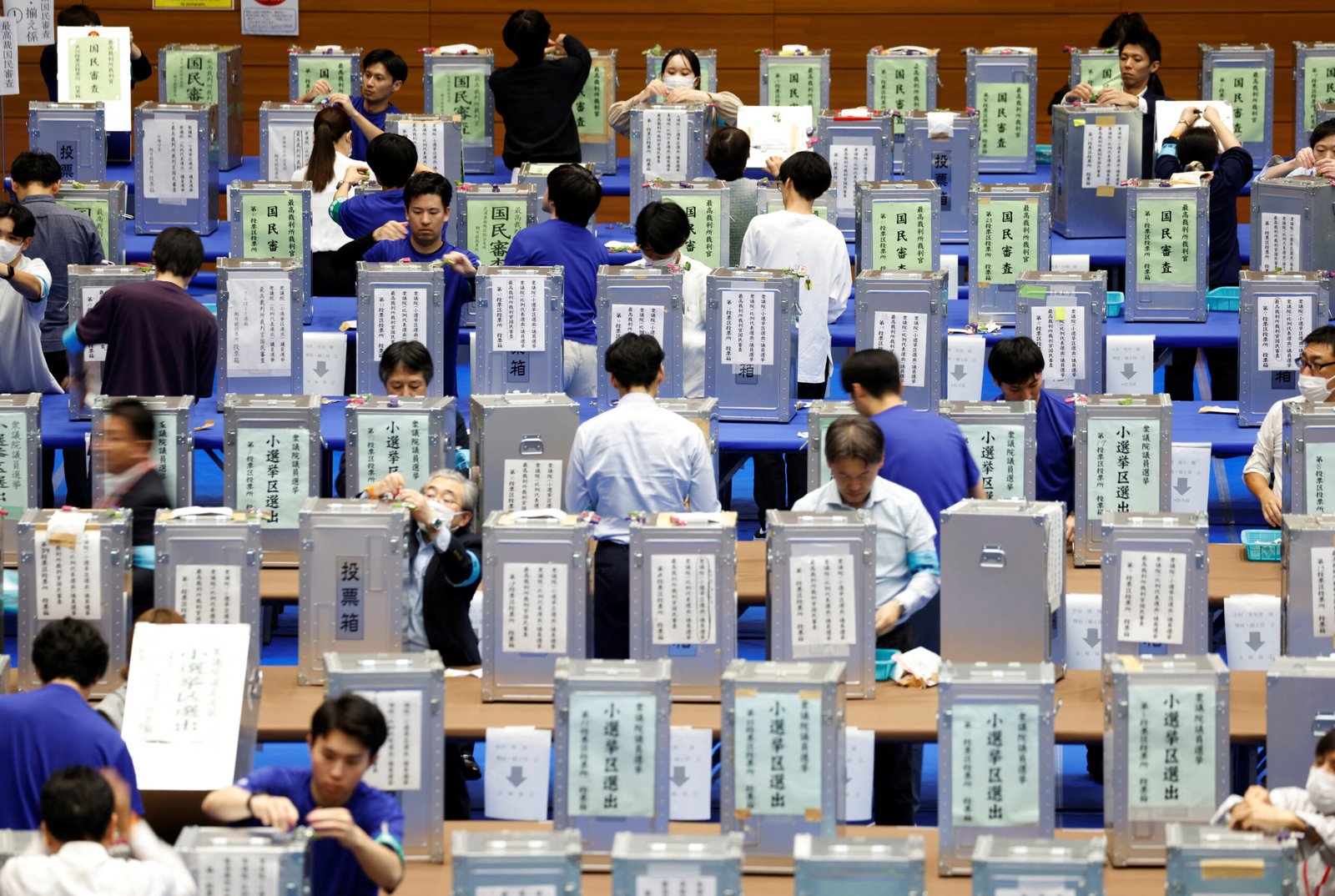




























































Japan’s financial markets are on edge as the nation heads into a pivotal Upper House election on July 20 that could dramatically shift the political balance and trigger economic turbulence. Concerns are mounting among economists and investors that a major loss by the ruling coalition may ignite a “triple whammy” scenario—simultaneous shocks to stocks, the yen, and government bonds—drawing comparisons to past crises in the U.S. and U.K.
Hideo Kumano, chief economist at Dai-Ichi Life Research Institute, warned of the risk of a Japan-specific version of the so-called “Trump crisis” or the market meltdown triggered by former U.K. Prime Minister Liz Truss’s 2022 budget plan. “A landslide loss for the ruling LDP-Komeito coalition could result in sharp market reactions,” Kumano said, citing the risk of aggressive tax cut proposals from newly empowered opposition parties.
Current polls indicate a surge in support for both far-right and progressive parties, potentially leading to a fractured parliament. The LDP-Komeito alliance, which already lost control of the Lower House last year, is now at risk of ceding its Upper House majority. A loss would leave Prime Minister Shigeru Ishiba in a weakened position, sparking political uncertainty and likely requiring delicate negotiations with minor parties to maintain governance.
This political fragility comes at a critical moment for Japan’s economic and trade agenda. With a looming 25% “reciprocal tariff” set to hit Japanese exports to the U.S. on August 1, any leadership vacuum could severely hamper last-minute negotiations with Washington. Without a breakthrough, Japanese exports—currently facing a 10% rate—would be subject to the full tariff, alongside existing 25% duties on autos and 50% on steel and aluminum.
Kohei Okazaki, chief market economist at Nomura Securities, warned that this uncertainty could force the Bank of Japan (BOJ) to delay its next interest rate hike. “The timing and content of a tariff agreement with the U.S. are increasingly unclear. This places added pressure on the BOJ’s monetary policy calendar,” Okazaki wrote in a recent note.
Adding fuel to the fire, opposition parties have been pushing for bold stimulus measures, including cutting Japan’s 10% consumption tax—currently levied on most goods—and its reduced 8% rate on food. While such proposals may win over voters concerned about inflation and economic stagnation, they also risk straining Japan’s already fragile fiscal position.
“Post-election, Japan will undoubtedly face greater fiscal pressures,” Kumano noted. Even if the ruling coalition maintains control, political analysts expect the government to roll out new economic relief packages to counteract any damage from U.S. tariffs.
Markets have already started responding to the growing uncertainty. The yen has weakened against the U.S. dollar in recent weeks, reflecting both domestic political instability and shifting expectations about Federal Reserve policy. Meanwhile, Japanese equities have retreated from recent highs, and government bond yields have surged. The 30-year Japanese government bond yield climbed to a record 3.2% on Tuesday, while the 20-year yield reached levels not seen since November 1999.
These developments suggest that investors are pricing in potential upheaval. Still, experts caution that the worst may not yet be reflected in current valuations. “It’s possible markets haven’t fully accounted for a worst-case scenario,” said Noriatsu Tanji, chief bond strategist at Mizuho Securities. “Volatility may spike after the vote if coalition losses are more severe than anticipated.”
Tanji also commented that while a temporary tax cut may not pose a fundamental threat to Japan’s long-term fiscal health, markets are often driven by sentiment rather than fundamentals. “It’s like a healthy bank being hit by a run due to rumors,” he explained.
As for the yen, Tanji suggested that U.S. monetary policy will play a larger role in determining its trajectory. “Japan’s fiscal expansion alone won’t tank the currency,” he said. “In fact, we expect the U.S. Federal Reserve to begin cutting rates as early as September, which could place modest upward pressure on the yen.”
Despite the cautious optimism about external factors, the domestic political landscape remains a wildcard. With high-stakes tariff negotiations, a fragile governing coalition, and opposition parties pressing for sweeping reforms, Japan’s economy could enter a period of prolonged instability.
As voters prepare to head to the polls, global investors will be watching closely—not only to see who wins, but what kind of policies might follow. The results could reshape Japan’s economic strategy and its place in the global trade order for years to come.